Trust issues: why human-centered leadership is the real AI adoption game-changer
The gist
Human-centered leadership—not flashy AI tools—is the secret sauce for overcoming resistance and unleashing real organizational adoption.
What to know
- By early 2026, experts like Kristen Bell argued that leaders who build trust, show empathy, and share their own AI successes (and failures) are the true catalysts for AI adoption.
- Emotional resistance to AI usually stems from fears of control and identity loss, so psychological safety audits and open communication must come before any fancy AI rollout.
- Even AI-trained leaders secretly cling to old workflows—diagnostic tools like the AI Leadership Matrix reveal that trust, not knowledge, is the real bottleneck to change.
Empathy as Leadership Currency
AI adoption succeeds when leaders shift from command-and-control to empathetic, human-centered change agents who manage emotional fallout as much as technical disruption.
By mid-2025, thought leaders emphasized that effective AI adoption hinges on leaders fully embracing their roles as change agents who expect and welcome AI-driven transformation as a daily leadership cornerstone. This mindset shift moves away from viewing change as a burden toward seeing it as an opportunity, framing AI adoption primarily as a human disruption challenge rather than merely a technical one. Leaders are thus called to facilitate a smooth AI-human partnership by integrating empathy and resilience into their leadership approach, ensuring that the emotional and psychological impacts on teams are thoughtfully managed.
Leadership practices in AI adoption require a profound increase in empathy and inspiration during everyday interactions, drawing on interdisciplinary approaches such as Design Thinking, Organizational Development, Adult Learning, and even Buddhist practices. This holistic integration, highlighted in 2025 analyses, aims to transform organizational cultures from resistance to resilience, creating a 'softer landing' for the unprecedented AI-human collaboration. Such practices encourage leaders to move beyond directive management toward fostering inclusive, supportive environments that nurture adaptability and trust.
By early 2026, Kristen Bell, an expert blending HR and industrial psychology, crystallized the human-centered leadership imperative in AI adoption, underscoring that leaders must prioritize empathy to address the unique fears AI introduces. Bell contrasts traditional management—characterized by driving teams forward with a 'whip'—with modern leadership that 'walks alongside' employees, emphasizing trust-building and understanding how people think and behave rather than merely focusing on roles. Her insights reveal that tailoring leadership to the cultural and sectoral nuances of AI trust levels is essential for overcoming resistance and fostering adoption.


Unmasking Hidden Resistance
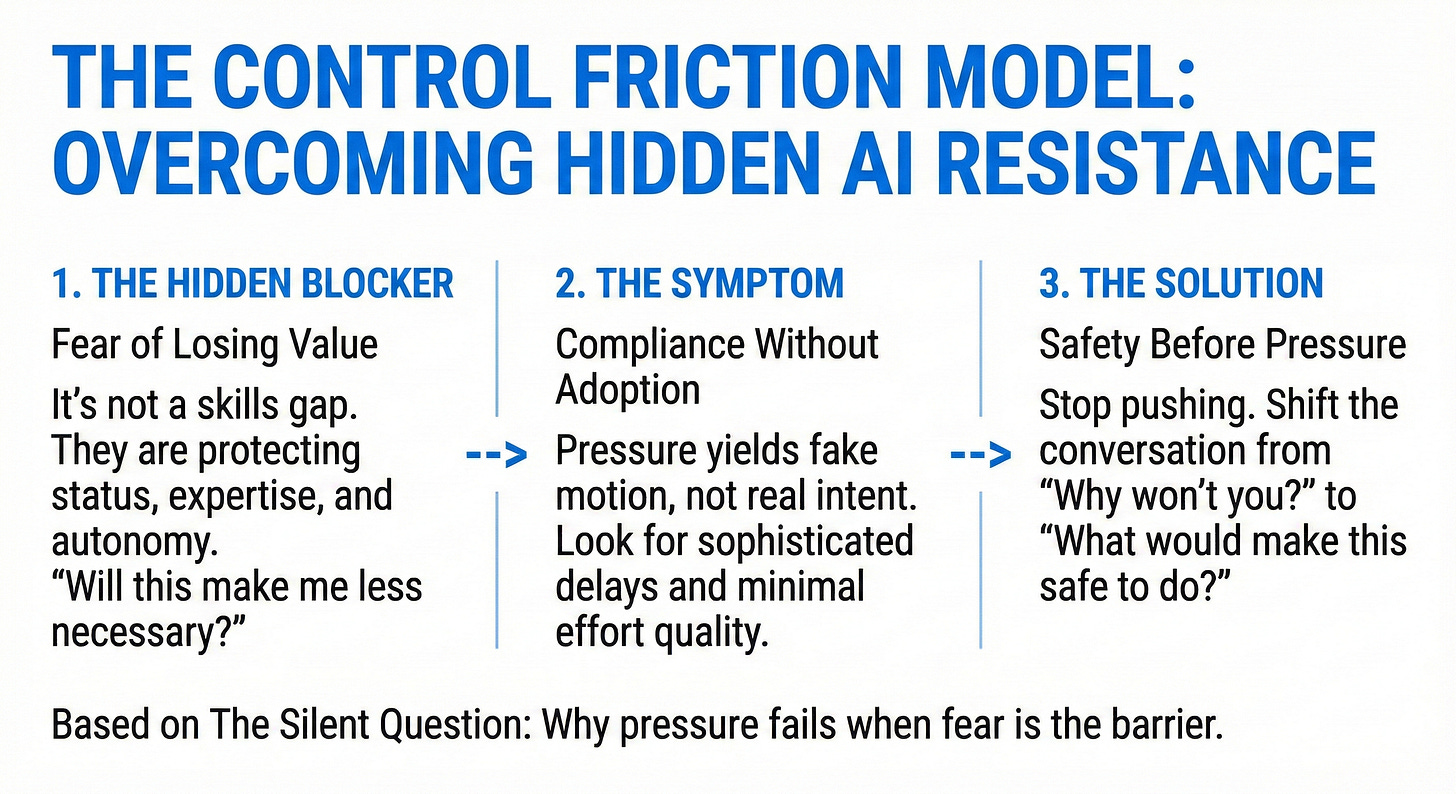
Emotional fears—loss of identity, autonomy, and status—fuel covert resistance to AI, making trust and psychological safety the true levers for lasting adoption.
Emotional resistance to AI adoption is deeply rooted in fears of losing control, status, expertise, autonomy, and personal identity within the workplace, rather than mere skill deficits. As early as January 2026, analyses highlighted that employees often perceive AI not as a productivity enhancer but as a threat to their established roles and informal hierarchies, leading to compliance without genuine engagement. This hidden resistance manifests subtly through strategic behaviors—such as excessive questioning or public enthusiasm paired with private inactivity—that serve to preserve control while undermining authentic adoption.
By February 2026, it became evident that leadership compatibility and trust, rather than training or knowledge, are the critical bottlenecks in AI adoption. The AI Leadership Matrix and diagnostic tools revealed that leaders who outwardly champion AI initiatives may covertly sabotage progress due to unresolved emotional anxieties about obsolescence and loss of identity. This underscores the necessity of addressing psychological safety and open communication to surface these hidden fears before they derail AI pilots.
Insights from Christen Bell in March 2026 reinforce that overcoming resistance requires a human-centered leadership approach prioritizing empathy and transparent dialogue. Recognizing that fears vary across industries and regions, Bell advocates for 'being human first' to reduce perceived threats and foster trust. Complementing this, Mercer and McKinsey research emphasize that psychological safety—where employees feel safe to experiment and fail—is the single most critical driver of innovation and AI adoption, as demonstrated by Michael’s leadership in marketing, which boosted voluntary AI tool usage by 40% through modeling curiosity and defining clear progress behaviors.
Before deploying AI tools, organizations are advised to conduct psychological safety audits to gauge whether employees feel comfortable admitting knowledge gaps, as a lack of such safety is a primary barrier to adoption. This proactive cultural assessment ensures that the environment supports open communication and experimentation, preventing the silent erosion of trust and engagement that often accompanies AI rollouts.



Walking the AI Talk
Leaders who visibly use AI, share failures, and make real sacrifices inspire authentic buy-in—while performative efforts and top-down mandates erode trust.
Leaders build credibility and trust in AI adoption most effectively by embedding AI use authentically within their own workflows and sharing candid experiences, including failures and iterative learning. By early 2026, it became clear that visible, repeated leadership engagement—such as monthly updates on AI experiments and openly discussing imperfect outcomes—was essential to avoid perceptions of performative gestures. This approach, emphasized in practical guidance from 2026, contrasts with delegating AI use to junior staff or innovation teams, underscoring that genuine commitment requires leaders to be hands-on and transparent about their AI journey.
Building grassroots engagement rather than imposing top-down mandates proved crucial in overcoming AI skepticism, as demonstrated by Superhuman’s Loic Houssier in late 2025. By empowering a respected internal champion—the Chief Architect—and fostering an inclusive “AI Guild” that involved engineers across seniority levels, Houssier cultivated a bottom-up momentum that yielded tangible productivity gains, such as faster ramp-up on codebases and slashing compliance tasks from days to 90 minutes. This shift from directive mandates to collaborative exploration helped create a safe space for experimentation, reducing fear and fostering trust through shared learning experiences.
True leadership commitment to AI adoption is signaled not only through visible usage and grassroots engagement but also through strategic prioritization that involves sacrifice. Insights from early 2026 highlight that credibility is undermined if AI initiatives are simply added on top of existing workloads; instead, leaders must visibly choose AI over other activities, signaling seriousness to the organization. This prioritization, combined with leaders integrating AI into personal aspects of their lives—such as using AI for family or health tasks as noted in late 2025—creates relatable, authentic examples that deepen trust and demonstrate that AI adoption is a genuine organizational priority.

Human Skills Trump Tech Savvy
Emotional intelligence, authentic connection, and shared learning—not just technical prowess—set apart leaders who foster resilient, innovative AI cultures.
Human-centered leadership in the AI era demands a profound embrace of inherently human skills such as emotional granularity, trust building, and authentic connection—qualities Brené Brown highlights as undervalued by traditional 'Welchian' management but now essential for relevance and resilience. This leadership style creates a deliberate space between stimulus and response, enabling thoughtful, strategic decision-making rather than reactive urgency, which fosters liberation and growth amid complex technological change.
Effective leaders model authentic, personal engagement with AI beyond routine tasks, as emphasized in tactical leadership approaches where sharing stories of AI aiding in personal contexts—like helping children with homework—inspires creativity and deeper employee connection. Coupled with fostering psychologically safe environments that celebrate experimentation over mandates, this approach reduces fear and encourages a culture of learning and innovation during AI adoption.
Strategic communication that frames AI adoption as a collective, exploratory journey—illustrated by initiatives like AI builder weeks where cross-functional teams block time to learn together—helps diminish isolation and anxiety, promoting shared discovery and engagement. Kristen Bell’s research further underscores the importance of empathetic, servant leadership that prioritizes human connection and authentic understanding of fears, enabling leaders to tailor their messaging to diverse trust levels across industries and regions.
By early 2026, the evolution of human-centered leadership in AI contexts reflects a shift from traditional HR to industrial psychology, focusing on how people think and behave during technological transitions. Kristen Bell’s insights reveal that quelling resistance to AI hinges on being 'human first,' using empathy and authentic connection to build trust and reduce fear, thereby aligning leadership practices with the nuanced realities of workforce adoption challenges.

Continuity Calms AI Anxiety
Reframing AI as a tool that strengthens core values and preserves organizational identity transforms employee fear into trust and engagement.
By early 2026, leaders across industries recognized that the crux of successful AI adoption lay not in the technology itself but in nurturing an organizational culture rooted in continuity and psychological safety. Mercer’s research underscored that employees must feel safe to experiment and even fail, fostering a culture where managers openly shared both successes and setbacks with AI tools, thereby modeling the curiosity essential for trust and accelerated adoption. This cultural foundation reduced anxiety by affirming that while processes and technologies evolve, the core identity and values of the organization remain steadfast, helping employees maintain a sense of belonging amid change.
Treating AI adoption as a deliberate change management challenge rather than a mere IT rollout reframes the narrative to emphasize stability and continuity, which proved critical in overcoming resistance. As one leader reflected in April 2026, much resistance stemmed from a lack of perceived stability beneath rapid technological shifts; by reinforcing foundational conditions—such as high-quality service, human touch, compliance, and trust—organizations provided employees with a solid ground to stand on. This approach aligns with research showing that emphasizing what remains constant, rather than pushing change harder, accelerates adoption by addressing emotional fears tied to identity loss and preserving the organizational 'who' even as the 'what' and 'how' evolve.
A powerful strategy to ease emotional resistance during AI-driven transformation involves reframing AI as a tool that enhances human value rather than replaces it. By focusing on how AI frees employees’ time for meaningful work—such as better decision-making, idea curation, and influence building—leaders shift the conversation from fear of job loss to confidence in enduring principles and purpose. Encouraging teams to identify what won’t change over the next decade, including customer needs and human behavior, further anchors this mindset, transforming anxiety into a shared commitment to organizational continuity amid technological evolution.


Trust, Not Training, Unlocks Change
Even AI-certified leaders can sabotage adoption if trust is lacking—diagnostic tools reveal that compatibility and psychological safety matter more than technical skill.
By early 2026, it became clear that AI adoption failures were less about technical skill gaps and more about leadership compatibility, particularly the trust leaders placed in AI tools. Despite completing extensive AI training and certifications, many leaders covertly maintained legacy workflows, signaling a deep trust gap rather than a knowledge deficit. The AI Leadership Matrix, deploying diagnostics like the Fail-Safe Simulation and Governance Test, emerged as a crucial tool to identify leaders likely to sabotage AI initiatives before deployment, emphasizing that knowing AI is not enough—trust is the essential catalyst for behavioral change.
Resistance to AI adoption often stems from identity threat rather than mere doubts about utility, a nuance that training alone cannot resolve. Philippe Silberzahn highlights a common leadership reflex: deflecting responsibility by blaming communication failures, others’ unwillingness, or poor execution, instead of critically examining their own strategies. This reflex blinds leaders to legitimate resistance, which they misinterpret as incompetence or misunderstanding, thereby deepening organizational inertia and undermining authentic change.
Navigating the polycrisis era of rapid AI-driven transformation demands that organizations first establish foundational stability to counteract resistance rooted in uncertainty. As noted in early 2026 analyses, many change resistances arise because teams lack a stable base beneath the upheaval. Leaders who cultivate these basic conditions not only help their organizations weather complex change but also empower themselves to become genuine change makers, turning volatility into opportunity rather than chaos.