TSMC’s $265b US bet triggers AI chip price surge
The gist
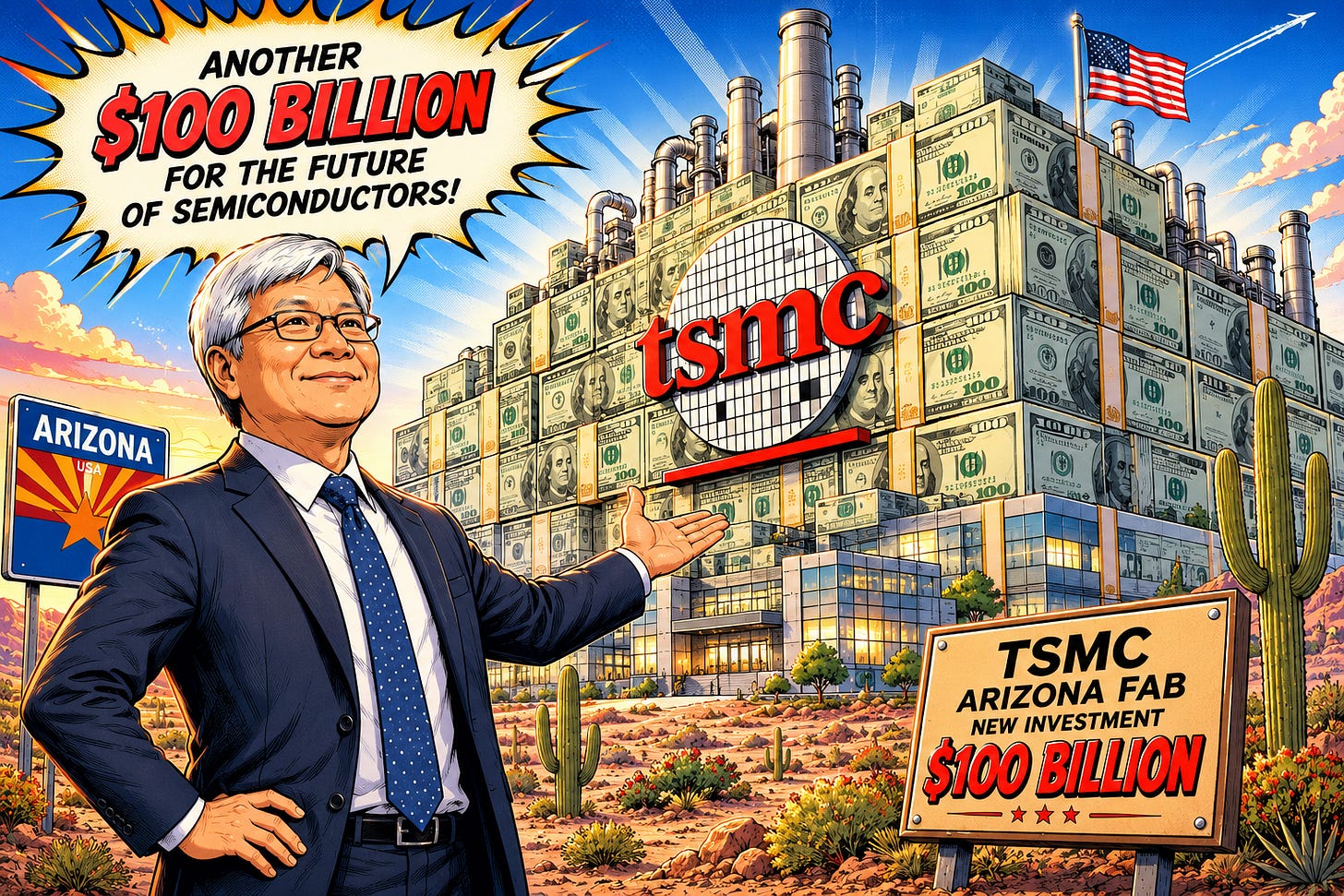
TSMC is betting $265 billion on U.S. soil, fueling a global AI chip boom—and an impending price surge that could reshape the semiconductor landscape.
What to know
- TSMC is pouring $100 billion into up to 10 advanced fabs and an R&D hub in Arizona, shifting manufacturing closer to U.S. tech giants under heavy geopolitical pressure.
- Sky-high American construction costs mean TSMC will hike chip prices by up to 10% starting in 2027, with some AI chips facing surcharges that could push costs up 25%.
- Armed with 73% global foundry market share and deep ties to Apple and hyperscalers, TSMC is locking in record AI demand—despite thinner margins from its costly U.S. expansion.
Geopolitics Reshapes Chipmaking
TSMC’s massive Arizona buildout is less about cost and more about securing supply chains and market dominance amid rising geopolitical stakes—even as it sacrifices margins for strategic localization.
TSMC's strategic localization in the U.S., particularly its unprecedented $265 billion investment with $100 billion dedicated to Arizona, marks a fundamental shift from globally optimized semiconductor manufacturing to a geographically distributed strategic infrastructure. This transition is driven by geopolitical pressures and the imperative to build domestic semiconductor capacity, with Arizona poised to host up to 10 advanced fabs, packaging plants, and an R&D center, creating a comprehensive industrial cluster that enhances supply chain security and proximity to key U.S. customers. As CFO Wendell Huang emphasized, this expansion is strongly supported by federal, state, and local governments, reflecting alignment with U.S. semiconductor localization policies and geopolitical imperatives.
The move towards localization is not just a commercial decision but a geopolitical strategy that carries a premium by mitigating risks from tariffs, government procurement rules, and trade policies. This new era of semiconductor manufacturing, exemplified by TSMC's Arizona expansion, is significantly more expensive due to increased government involvement, longer supply agreements, and higher production costs—U.S.-made chips can cost 20% to 50% more than those produced in Taiwan. CFO Wendell Huang noted that gross margin dilution from overseas fab ramp-ups will widen from 2-3% to 3-4% over the coming years, underscoring how resilience and geopolitical security now come at a tangible financial cost.
TSMC's aggressive U.S. investment also serves as a defensive move to maintain its market dominance against competitors like Intel and Samsung, who are similarly targeting advanced chip orders within the U.S. By expanding its Arizona footprint with state-of-the-art 2-nanometer and below process fabs and advanced packaging facilities, TSMC reduces the incentive for customers to switch to rivals due to local manufacturing mandates. This strategic localization thus not only secures supply chains amid rising AI chip demand but also preserves TSMC's pricing power and market share in a rapidly evolving geopolitical landscape.

Chip Prices Reflect U.S. Costs
TSMC’s U.S. expansion forces chip prices sharply higher, with customers absorbing up to 25% surcharges as American manufacturing costs run up to five times higher than Taiwan.
TSMC's planned chip price increases of up to 10% starting in early 2027 are a direct response to the soaring input and construction costs tied to its expansive U.S. manufacturing footprint, particularly the record $265 billion global expansion with $100 billion dedicated to U.S. fabs. CFO Wendell Huang highlighted that construction costs for U.S. fabs run four to five times higher than in Taiwan, necessitating these strategic price hikes to sustain profitability amid elevated capital expenditures projected at $60–64 billion for 2026.
The margin pressures from U.S. manufacturing mandates and higher labor and supply chain costs are expected to dilute TSMC's gross margins by 2% to 4% over the next several years, despite the company's dominant market position controlling roughly 73% of the global pure-play foundry market. CEO C.C. Wei underscored this supply-demand imbalance, noting, 'The demand and the supply, the gap is so big, so we are working very hard to narrow the gap,' which reinforces TSMC's pricing power even as customers face inevitable cost increases.
Advanced node chips, which accounted for approximately 77% of TSMC's Q2 2026 revenue, will see base price hikes between 5% and 10%, with additional surcharges of 10% to 15% for orders exceeding volume commitments—potentially pushing some AI chip costs up by as much as 25%. Analysts estimate that U.S.-made chips cost 20% to 50% more than those produced in Taiwan, costs that customers are largely expected to absorb, reflecting the structural challenges posed by TSMC's strategic but costly U.S. expansion.
Despite the margin headwinds introduced by its massive U.S. investments, TSMC views these price hikes and expanded manufacturing presence as a necessary defensive strategy to protect its market share and pricing power amid intensifying geopolitical risks and U.S. policy mandates. This approach underscores the delicate balance TSMC must maintain between absorbing higher costs and leveraging its dominant position to pass on expenses without ceding ground to competitors.
AI Supercycle Drives Tech Shift
Explosive AI demand is pushing TSMC to prioritize advanced nodes and packaging, transforming its technology roadmap and capacity planning to serve next-gen, agentic AI workloads.
Surging AI demand is fundamentally reshaping TSMC’s wafer allocation and technology roadmap, driving a shift from general-purpose chips to specialized AI processors optimized for orchestration-heavy workloads. Leading hyperscalers and chip designers like Nvidia, AWS, AMD, and Google are developing integrated CPU+GPU+interconnect+memory+software bundles tailored for agentic AI, influencing TSMC’s prioritization of advanced nodes such as 2nm and 3nm to meet these evolving compute requirements. As CEO C.C. Wei highlights, the AI supercycle has changed the shape of compute without altering its overall size, necessitating a more nuanced approach to capacity planning and technology investments.
TSMC’s capital expenditure strategy reflects a calibrated response to AI-driven demand, with 2026 CapEx raised to $60-$64 billion and 70%-80% focused on advanced process technologies like N2 and N3. Despite the unprecedented demand, TSMC maintains a more conservative spending ratio of 34-36% of revenue compared to the pandemic supercycle’s 53%, signaling cautious optimism amid complex market dynamics. This approach includes extending the lifecycle of mature nodes such as N3 and N5 through multiple variants and new fabs to balance capacity expansion with margin preservation, as these nodes continue to support a significant portion of AI workloads with strong profitability.
Advanced packaging technologies, particularly CoWoS, are a critical pillar of TSMC’s AI-driven expansion, with capacity fully booked through 2027 and plans underway for a 14-reticle CoWoS package by 2028 to dramatically increase compute density and memory integration. This packaging innovation supports the complex multi-chip architectures demanded by next-generation AI accelerators, enabling faster and more energy-efficient interconnects that are essential for high-performance AI workloads. The integration of packaging plants alongside fabs in TSMC’s Arizona cluster underscores the strategic importance of end-to-end chip assembly in meeting AI compute needs.
TSMC’s capacity build-out is tightly aligned with real AI deployment timelines and customer engagements, reducing inventory risk and ensuring demand-driven expansion. By collaborating closely with hyperscalers and evaluating factors such as deployment schedules, power availability, and infrastructure readiness, TSMC ensures that wafer production scales in concert with actual AI market growth. This disciplined approach underpins the company’s confidence in sustaining over 40% revenue growth in 2026, as advanced nodes now represent 77% of wafer revenue with 2nm contributing for the first time and gross margins reaching 67.7%.


TSMC’s Growth Defies Cycles
Strategic customer partnerships and disciplined spending have turned TSMC into a resilient growth engine—though its record investments now test investor patience with thinner near-term margins.
TSMC has successfully transitioned from a traditionally cyclical semiconductor player to a stable growth powerhouse, underpinned by disciplined capital expenditure and long-term capacity planning closely coordinated with customers. This strategic approach has not only enhanced investor confidence—reflected in a permanent P/E re-rating from historical lows of 10-12x to current multiples between 25-30x—but also ensured consistently high capacity utilization and gross margins even amid global economic slowdowns, distinguishing TSMC from memory manufacturers plagued by overcapacity issues.
The company’s deep integration with marquee customers like Apple has created a formidable ecosystem that locks in clients through high switching costs, blending advanced process technology, IP, packaging, and design tools. Apple’s significant investments guarantee priority access to cutting-edge nodes such as 3nm, effectively sidelining competitors like Samsung and Intel for the most advanced fabrication processes, which are critical for evolving AI and data center workloads. This partnership exemplifies how TSMC’s customized offerings have shifted the foundry market from pure capacity selling to a value-added ecosystem, reinforcing its pricing power and market dominance.
Despite record-breaking earnings fueled by surging AI demand from customers like Nvidia, AMD, and Broadcom, TSMC’s aggressive capital expenditure—projected to reach $60-$64 billion in 2026 with an additional $100 billion earmarked for Arizona—has tempered market enthusiasm due to concerns over margin dilution and the long timeline before these investments yield free cash flow. Management’s guidance of a near-term gross margin contraction, partly from the 2nm ramp and overseas fab expansions, signals the capital-intensive nature of scaling advanced manufacturing globally, prompting investors to recalibrate expectations from immediate margin windfalls to sustainable long-term growth.
TSMC’s dominant position in advanced nodes, particularly the tightly constrained N3 process, cements its role as the semiconductor industry’s stable growth leader, with major AI chip designers like Nvidia, Google, Amazon, and Microsoft converging their flagship platforms on its technology. While Intel’s ramp-up of advanced node capacity in Arizona introduces competitive pressure, its current wafer sales remain minuscule compared to TSMC’s $40.2 billion quarterly revenue, underscoring the formidable moat TSMC enjoys through technological leadership and customer lock-in. This dynamic ensures TSMC’s wafer revenue is heavily weighted toward HPC and AI, driving a projected mid-to-high 50% AI growth CAGR through 2029.