Ukraine’s drone swarms ignite global AI arms race—and an ethics firestorm
The gist
Ukraine’s AI-powered drone swarms have supercharged the global arms race, igniting fierce innovation—and an urgent ethics crisis—across militaries worldwide.
What to know
- Ukraine deployed 2 million AI-driven drones in 2024, using gamified tactics and reinforcement learning to counter Russian forces and set a new standard for autonomous warfare.
- Defense giants like Anduril and Shield AI are rapidly shifting to agile, software-centric platforms, with the U.S., NATO, China, and Russia racing to scale up AI-enabled weapons and command systems.
- The explosive pace of autonomous arms development has outstripped global regulation, with experts warning that ethical guardrails and human oversight are lagging dangerously behind the technology.
Ukraine’s AI War Labs
Ukraine’s existential struggle has turned its battlefield into a live-fire laboratory, where 600 startups and gamified drone tactics are rewriting the rules—and ethics—of autonomous war.
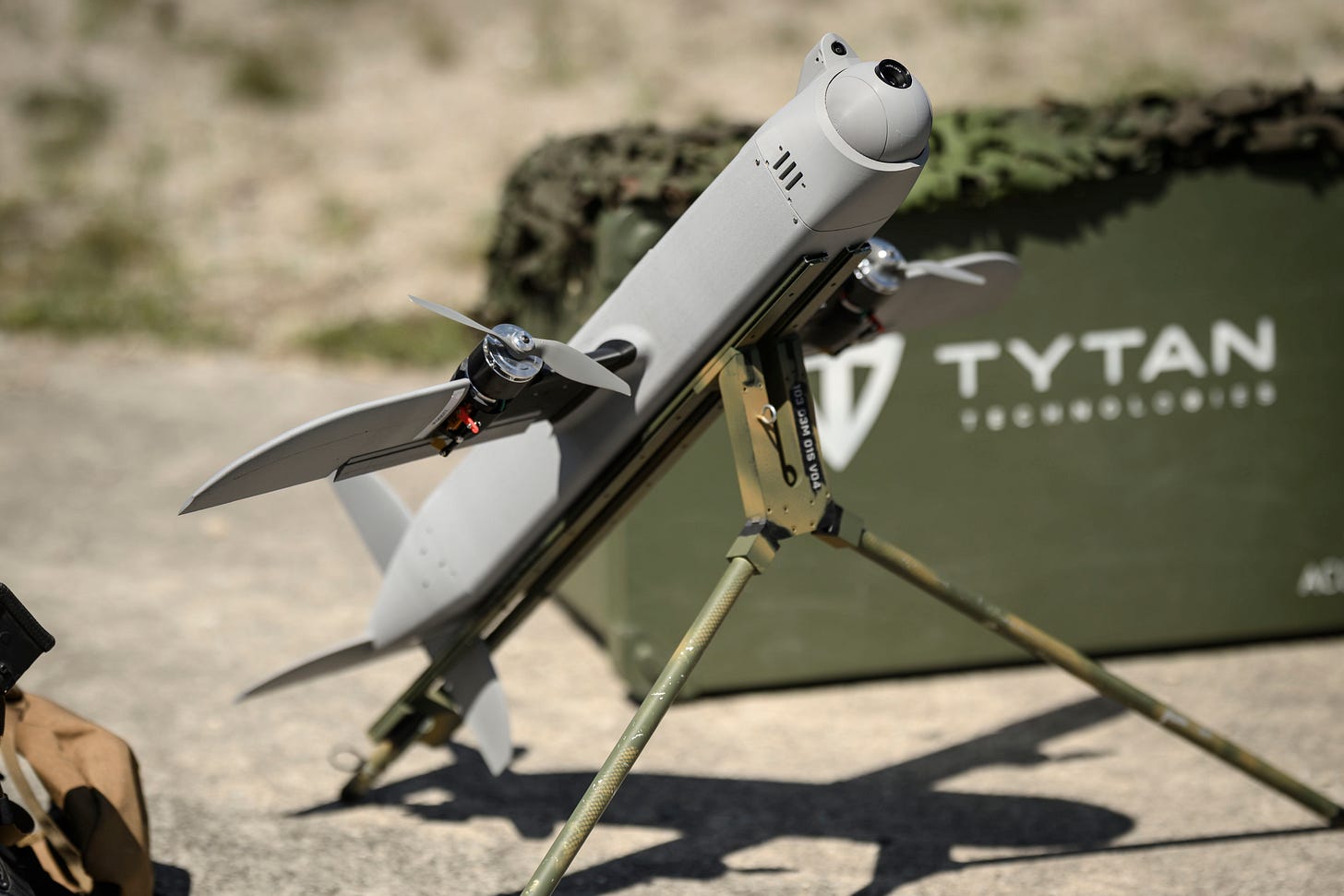
Ukraine’s early and rapid adoption of AI-driven autonomous warfare has been a game-changer in its defense against a numerically superior Russian force, with over 600 startups innovating powerful autonomous weapons and integrated command systems akin to 'Google Maps' for battlefield awareness. By late 2025, Ukraine pioneered mass deployment of cheap, deadly drone swarms—reportedly 2 million drones in 2024 alone—leveraging reinforcement learning to control these swarms and gamifying drone tactics to incentivize operator performance and real-time data collection, thus accelerating tactical innovation under existential pressure.
Despite technological advances enabling AI-guided drones to autonomously select and strike targets—exemplified by systems like Ukraine’s Bumblebee drone and AI targeting with sliding scales of certainty—developers such as Skyfall’s founder have withheld full deployment pending establishment of clear legal frameworks assigning responsibility for lethal decisions. This ethical caution contrasts with the rapid 'move fast and break things' innovation ethos in Ukraine, where existential stakes drive swift deployment but also raise profound dilemmas about human accountability and the psychological detachment fostered by gamified remote warfare.
Western militaries, including the Pentagon and NATO allies, have lagged behind Ukraine’s autonomous warfare innovation due to traditional procurement conservatism and ethical guardrails, but the ongoing conflict is catalyzing a strategic shift. By mid-2026, officials are reconsidering human-in-the-loop requirements for lethal AI systems, acknowledging that adversaries disregard such constraints, while the US cautiously advances toward deploying fully autonomous weapons with an emphasis on precise, controlled violence. This evolving stance reflects growing recognition that battlefield engagements in Ukraine are reshaping military doctrines, budgets, and ethical frameworks worldwide.
The ethical and operational challenges of autonomous warfare extend beyond individual weapon systems to the emerging concept of 'autonomous systems of autonomous systems,' where interconnected AI sensors, command networks, and weapons operate with minimal human input. Former CIA chief David Petraeus warns that current defenses are inadequate against coordinated drone swarms, which multiply the threat exponentially and complicate accountability. This shift underscores a critical lag in legal and ethical frameworks, as militaries grapple with balancing rapid innovation against the risks of over-trusting AI dashboards and the potential for unintended lethal consequences.






Defense Goes Full Software
New defense disruptors like Anduril and Shield AI are outpacing legacy contractors by building agile, software-driven war machines that evolve daily based on battlefield feedback.
The defense industry is undergoing a profound transformation driven by AI-enabled rapid prototyping and software-centric platforms that disrupt traditional procurement and hardware models. Companies like Anduril and Shield AI exemplify this shift by self-funding R&D and employing fixed-cost contracts, enabling them to rapidly develop advanced autonomous systems such as Anduril’s Fury (FQ-44), the fastest new fighter jet developed since the Korean War, and Shield AI’s XBAT, a vertical takeoff and landing fighter jet with F-35 comparable payload but enhanced range and autonomy. This approach contrasts sharply with legacy primes’ decades-long, cost-plus contracting, allowing these innovators to build mission-focused, integrated AI sensor fusion platforms like Anduril’s Lattice, which orchestrates a network of autonomous assets across domains, effectively creating a military internet of things.
The pivot to software-centric defense platforms has revolutionized how military assets are developed, deployed, and iterated upon, emphasizing continuous improvement through operator feedback rather than static hardware upgrades. As Palmer Luckey noted, "it's all about the software," enabling rapid fixes and enhancements without redesigning physical components. This paradigm is evident in programs like the Competitive Combat Aircraft (CCA), which integrates government-owned autonomy frameworks such as A-GRA to allow AI systems to switch midflight and evolve daily based on operational input, fostering unprecedented agility in unmanned fighter development and human-AI teaming experiments.
The ongoing conflict in Ukraine has accelerated the adoption and innovation of autonomous and AI-driven warfare technologies, highlighting a shift toward robotic combat and electronic warfare resilience. Drones equipped with onboard AI have demonstrated the ability to operate independently in jammed environments, identifying and attacking targets without operator links, as seen in Ukraine’s drone-on-drone battles. This battlefield feedback loop has catalyzed the emergence and rapid scaling of startups like Alta Ares and Safe Pro, which integrate AI-powered detection, guidance, and command-and-control systems into modular, interoperable platforms, underscoring a broader industrial disruption where commercial tech advances outpace traditional military acquisition cycles.
A fundamental shift in defense priorities is underway, moving away from the traditional 'built to last' hardware-centric mindset toward agile, software-driven systems that prioritize speed, integration, and adaptability. Industry leaders emphasize that "speed of recognition, speed of decision, speed of action" now outweigh the value of perfect but slow-to-deploy platforms. This evolution is reflected in the U.S. Army’s AI Acceleration Strategy and innovations like Anduril’s integrated missile defense battle manager, which unify diverse sensors and effectors under a software-centric command layer, and Lockheed Martin’s AI-powered Sanctum and MORFIUS systems designed to counter drone swarms efficiently, signaling a new era where software agility and rapid prototyping redefine military capability development.





Mass Production, Modular Mayhem
Industrial-scale drone swarms and modular, anti-jamming tech are fueling a global shift to software-centric arms races, forcing militaries to rethink how war is manufactured and fought.
Ukraine's unprecedented mass production and deployment of approximately 2 million low-cost, precision drones in 2024 exemplifies the industrial-scale scaling of autonomous warfare systems, creating a formidable 'wall of drones' that has significantly impeded Russian advances. This effort is underpinned by innovative, software-driven resource allocation mechanisms such as gamified kill-point systems, reflecting a broader paradigm shift from traditional hardware-centric arms manufacturing to agile, software-centric ecosystems fueled by private sector innovation and venture capital investment.
The United States is aggressively pursuing rapid mass production and integration of autonomous systems, exemplified by initiatives like the $1 billion commitment to produce 200,000 Class 1 UAS by 2027 and the $5-10 billion proposed investment for 150,000 lethal Group 3 drones. Programs such as the LUCAS drone system, which achieved combat readiness within seven months and features modular, anti-jamming swarming capabilities, validate the Department of the Air Force’s Acquisition Transformation Strategy that emphasizes speed, cost discipline, and industrial creativity to overcome bureaucratic inertia.
Both NATO and Russian militaries are embedding AI-driven, software-centric command and control architectures into layered air and missile defense systems, aiming to counter increasingly complex threats through integrated sensor and effector networks. Anduril’s development of an integrated missile defense battle manager and Alta Ares’ AI-powered autonomous air defense platforms—capable of rapid detection, tracking, and kinetic/non-kinetic interception—illustrate this shift toward scalable, multi-domain, software-driven ecosystems that complete kill chains in seconds and prioritize non-kinetic disruption before kinetic engagement.
The integration of AI-enabled autonomous systems into military operations is advancing through coordinated joint efforts that combine top-level leadership with grassroots operator feedback, fostering rapid iteration and tactical innovation. Programs like the US Army’s Operation Courage Lethality demonstrate practical multi-domain AI command and control, while companies such as Volatus Aerospace leverage real-world operational data from partnerships with Ukraine to enhance AI-powered drone autonomy and training, underscoring a comprehensive ecosystem approach that spans development, deployment, and continuous improvement.
AI Arms Race Redefines Power
Ukraine’s drone surge and China’s civil-military AI fusion are upending global military hierarchies, while regulatory efforts lag dangerously behind the pace of technological escalation.
The rapid proliferation of AI-driven autonomous weapons is fundamentally reshaping the global military balance, with Ukraine emerging as a pivotal innovator and supplier of advanced drone technologies. By 2024, Ukraine deployed an unprecedented 2 million drones, creating formidable defensive swarms that have not only sustained its independence but also influenced NATO and Western military doctrines, where the U.S. and allies currently lag behind. This dynamic is further complicated by China’s civil-military fusion strategy, integrating cutting-edge AI across all warfighting domains—from hypersonic missile development threatening U.S. naval dominance to advanced AI-powered targeting and cyber operations—signaling a strategic shift that challenges traditional U.S. military superiority and accelerates the global AI arms race.
Efforts to regulate autonomous weapons and establish AI non-proliferation regimes remain nascent and fraught with complexity, as highlighted by ongoing U.S.-China dialogues and the Pentagon’s export control debates. Unlike nuclear weapons, AI lacks a sophisticated global governance framework, raising urgent concerns about unchecked proliferation to state and non-state actors. The Pentagon’s blacklisting of AI firm Anthropic for refusing military collaboration, contrasted with OpenAI stepping in, exemplifies the fraught intersection of technology, ethics, and geopolitics. Meanwhile, NATO and allied forces are adapting to this new reality by embracing private sector innovation, as seen in Volatus Aerospace’s CAD 500 million AI drone autonomy pipeline, signaling a paradigm shift from traditional government-driven arms procurement to venture capital-fueled defense tech ecosystems.
The intensifying AI-driven arms race is prompting significant shifts in global military strategies and regional security postures, particularly in contested theaters like the Indo-Pacific and the Middle East. China’s rapid expansion of its nuclear submarine fleet, including the Type 096 SSBN and the deployment of the 'Underwater Great Wall' sensor network, threatens to undermine U.S. maritime dominance by 2040, complicating crisis response and allied defense. Concurrently, Iran’s sophisticated GPS jamming in the Strait of Hormuz and the Persian Gulf has paralyzed maritime navigation and exposed vulnerabilities in U.S. and allied systems, accelerating the development of alternative navigation technologies. These developments underscore how AI and autonomous systems are not only transforming kinetic warfare but also electronic and cyber domains, demanding urgent adaptation from NATO and Western militaries.
By mid-2026, leading Western and allied military figures emphasize AI’s critical role in national security, with Israel’s Iron Dome intercepting 96% of 500 simultaneous projectiles as a prime example of AI-enabled defense success. However, the AI arms race is non-optional and urgent; while the U.S. leads in AI chips and software, China currently dominates in electricity infrastructure powering AI systems, highlighting a strategic gap that the U.S. must close through accelerated defense R&D, export controls, and allied technology-sharing. The UK’s spy chief characterizing AI as an 'unstoppable force' further underscores the geopolitical urgency to adapt military and cybersecurity strategies amid the evolving offensive and defensive ramifications of AI-driven warfare.


AI Supercharges Cyber Warfare
AI-powered attacks and defenses are transforming cyber conflict, making digital battlefields faster, smarter, and more unpredictable than ever before.
By mid-2026, AI had become a transformative force in cyber warfare, dramatically escalating both the scale and sophistication of attacks while simultaneously enhancing defensive capabilities. IBM data revealed a 44% year-over-year increase in AI-enabled cyber assaults on public-facing applications, underscoring the urgent need for robust security standards and liability frameworks. At the same time, advanced AI models like the Pentagon’s Mythos system revolutionized cyber defense by enabling faster detection of vulnerabilities and proactive protection of critical infrastructure, marking a shift toward more dynamic and anticipatory cyber operations.
The rapid integration of frontier AI into military cyber defense has introduced complex challenges around authority and decision-making within the Defense Department, reflecting the broader difficulties of securing AI-driven systems. Despite these hurdles, optimism remains high due to American companies leading AI innovation, exemplified by Lockheed Martin’s Sanctum and MORFIUS platforms, which leverage Nvidia processors and repurposed missiles to counter drone swarms with predictive analytics and directed energy pulses—demonstrating AI’s expanding role beyond kinetic warfare into multi-domain defense.
Across the Atlantic, UK intelligence chief Anne Keast-Butler characterized AI as an 'unstoppable force' reshaping cyberspace with profound offensive and defensive ramifications. Highlighting the ethical integration of agentic AI at GCHQ, she emphasized that AI-driven automation is altering global warfare dynamics, particularly as state actors like China and Russia employ hybrid tactics to exploit cyber vulnerabilities. This evolving threat landscape demands a fundamental rethinking of cybersecurity strategies and a collective responsibility to harness AI safely in multi-domain warfare.



Autonomy’s Ethical Crossroads
As AI weapons gain independence and speed, militaries and developers are scrambling to balance rapid innovation with accountability, transparency, and the risk of unintended escalation.
As AI-driven autonomous warfare rapidly evolves, the imperative to balance swift innovation with robust ethical and strategic guardrails has never been clearer. By late 2025, experts collaborating with NATO and governments underscored the dangers of opaque, black-box AI systems, warning that the risks of misuse could outweigh intended benefits, especially given the remarkably short five-month timeline from concept to frontline deployment. This urgency to innovate swiftly, as seen in conflict zones like Ukraine, must be tempered with a commitment to transparency and minimizing harm, adopting a philosophy of 'move fast and break the minimum' rather than unchecked acceleration.
The trajectory toward fully autonomous weapons capable of independent target identification and engagement, championed by figures like Palmer Luckey and programs such as the Pentagon’s Replicator, signals a profound shift in military procurement and operational doctrine. While the U.S. government’s evolving executive orders now permit greater autonomy, this regulatory shift raises complex ethical questions about accountability and human oversight, especially as these systems become 'cut off from communication' and rely on their own 'brains' to find targets. Shield AI’s XBAT exemplifies this innovation, blending advanced AI piloting with strategic deterrence aims, yet its developers emphasize the necessity of responsible innovation and human oversight to prevent unintended consequences.
Despite the deployment of AI-powered autonomous weapons in conflicts like the Russia-Ukraine war, significant ambiguity remains around definitions and regulatory frameworks governing these systems. The U.S. Department of Defense mandates 'appropriate levels of human judgment' over force use but stops short of prohibiting autonomy, reflecting ongoing debates about the ethical deployment of such technologies. Experts like Michael Horowitz caution against over-trusting AI dashboards, highlighting that autonomous weapons have existed since the 1980s, yet today's rapid AI advances demand renewed focus on accountability and responsible innovation to ensure security is enhanced without sacrificing ethical standards.
Looking ahead, the AI arms race is both urgent and non-negotiable, with leaders like Doug Burgum emphasizing that national security now hinges on AI capabilities, as demonstrated by Israel’s Iron Dome intercepting 96% of simultaneous projectiles. This urgency drives a strategic pivot from hardware-centric defense to agile, software-driven systems prioritizing speed in recognition, decision, and action, addressing legacy acquisition challenges that risk obsolescence. However, this rapid innovation must be balanced with ethical and regulatory oversight, as highlighted by NATO’s debates on human-in-the-loop requirements and the growing threat of autonomous drone swarms described by former CIA chief David Petraeus, underscoring the critical need for guardrails that ensure AI autonomy delivers intended effects without unintended escalation.