US draws hard line: allies must pick AI side or lose perks
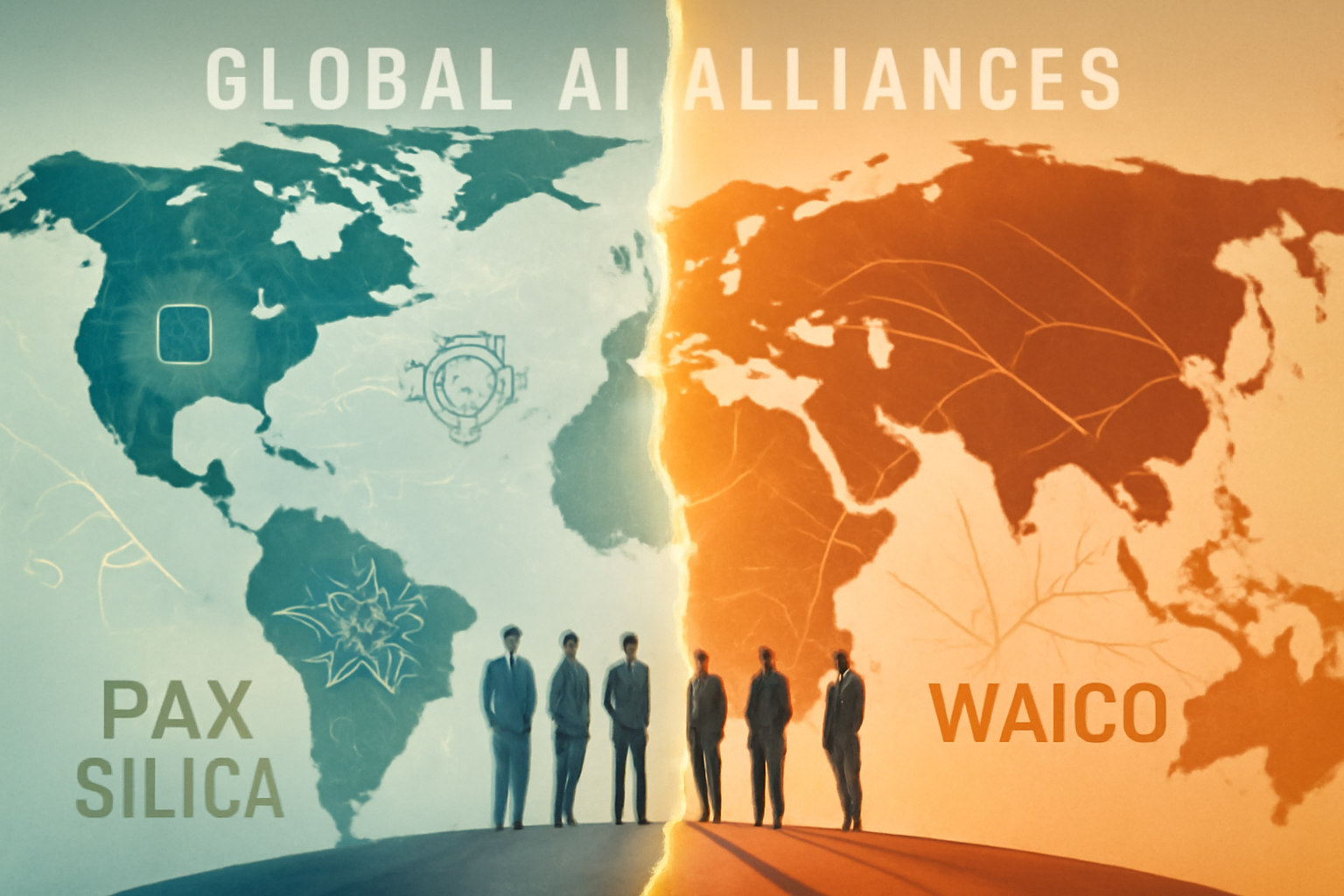
The gist
The US is forcing allies to pick sides in the global AI race—either join Washington’s Pax Silica club or risk losing access to next-gen chips, supply chains, and tech investment.
What to know
- Pax Silica unites two dozen nations—including Japan, South Korea, and the Philippines—under strict exclusivity, with a $40–70B AI and semiconductor hub launching in New Clark City.
- Countries flirting with China’s AI frameworks risk being cut off from critical US-backed semiconductor exports and hardware upgrades.
- Kazakhstan’s attempt to play both sides spotlights the diplomatic headaches and high-stakes maneuvering over access to minerals, tech, and market power.
AI Alliances Draw Battle Lines
The US is forcing nations to pick sides in the AI race, leveraging semiconductor access and export controls to fracture the global tech landscape and punish those who hedge their bets.
The US-led Pax Silica initiative is decisively enforcing an exclusivity policy that compels allied and partner nations to choose between its AI alliance and China's competing frameworks, explicitly disallowing dual membership. This binary choice is not merely symbolic but a strategic maneuver to bifurcate the global AI landscape into American computational supremacy versus Chinese market integration, with significant diplomatic pressure applied to ensure alignment. The exclusivity demand is underscored by warnings that participation in Chinese AI ecosystems risks exclusion from advanced semiconductor supply chains and critical AI hardware upgrades, effectively making AI alliance membership a high-stakes geopolitical commitment.
Washington enforces this exclusivity through stringent export controls and the foreign direct product rule, threatening sanctions on any entity that supports Chinese AI projects using American intellectual property. This regulatory tightening limits technological neutrality and coerces countries to align strictly with the US-led ecosystem, which demands adherence to rigorous data governance, human rights standards, and premium pricing. Meanwhile, emerging economies face a difficult strategic dilemma as Chinese AI solutions offer more affordable, turnkey infrastructure often backed by state financing, complicating their alignment decisions amid competing economic and ethical incentives.
Kazakhstan exemplifies the diplomatic and strategic tensions inherent in these exclusivity demands, as it uniquely holds membership in both Pax Silica and China's World Artificial Intelligence Cooperation Organization (WAICO). This dual participation exposes vulnerabilities in the US-led framework and highlights the geopolitical value of Kazakhstan's critical mineral reserves essential for semiconductor production. Despite US efforts to enforce exclusivity through draft letters warning that 'to be part of everything is to be part nothing,' Kazakhstan's multi-vector foreign policy reflects the challenges many nations face in balancing practical resource interests with the polarized AI alliance landscape.
The exclusivity policy within Pax Silica integrates control over the entire AI technology stack—from rare earth mineral extraction through semiconductor fabrication to AI deployment—into a unified security framework involving key partners like the EU, Japan, South Korea, India, and the UAE. This comprehensive governance model aims to secure trusted supply chains and protect sensitive technology, contrasting with China's WAICO approach that emphasizes inclusive civilian AI cooperation and narrowing technological gaps. As the US formalizes exclusivity requirements, countries such as Italy face increasing diplomatic pressure to choose sides, signaling a shift from hedging strategies toward a polarized global AI order defined by trust and supply chain allegiance.

New Clark City: AI Power Play
America’s $70B AI hub in the Philippines is both an economic carrot and a strategic gambit, putting Manila at the center of a high-stakes balancing act between growth, environmental risks, and Chinese retaliation.
The Pax Silica initiative represents a strategic effort by the United States to forge a resilient AI supply chain by uniting roughly two dozen allied countries, including Japan, Australia, South Korea, and the Philippines, to reduce dependency on China. This coalition targets the entire AI supply chain—from semiconductors and critical minerals to AI models and export controls—integrating industrial policy with foreign policy to restrict adversaries’ access to critical infrastructure while making alliance membership economically and strategically attractive.
Central to Pax Silica’s industrial strategy is the establishment of a US-backed AI and semiconductor technology hub in New Clark City, Philippines, situated on a former US military reservation. This 4,000-acre AI-native industrial complex aims to attract between US$40 and 70 billion in investments and create over 130,000 jobs, fostering a manufacturing-driven ecosystem that integrates semiconductors, AI, advanced manufacturing, and critical mineral processing, thereby reinforcing the US-Philippine alliance within the broader friend-shoring framework.
While the Philippines’ participation in Pax Silica is framed by President Ferdinand Marcos Jr as a pragmatic economic partnership focused on job creation and infrastructure investment rather than a geopolitical stance against China, the country faces challenges balancing economic benefits with environmental concerns and potential Chinese retaliation. Environmental groups warn of agricultural displacement and aquifer depletion, while experts caution that China may tighten economic and security pressures, including export restrictions, complicating Manila’s strategic calculus.
Currently positioned primarily in the back-end semiconductor supply chain through assembly, testing, and packaging, the Philippines aspires under Pax Silica to ascend to higher-value activities like chip design and wafer fabrication. However, this transition hinges on more than new facilities; it requires cultivating local talent, research capabilities, and indigenous companies to sustain technological control, lest the country remain a production site dominated by external industries despite its growing strategic importance in the AI supply chain.

Building Allied Tech Sovereignty
Pax Silica is forging a resilient, integrated AI ecosystem among allies—moving beyond chips to secure every link in the supply chain and lock in shared technological leadership.
Pax Silica is cultivating a robust ecosystem of allied innovation by leveraging each member country's distinctive strengths to promote genuine tech sovereignty, defined not merely as domestic replication but as active contribution to shaping future technologies. This approach fosters shared prosperity by encouraging countries and companies to fully integrate AI into their economies, a necessity underscored by the Council of Economic Advisors’ findings that lagging in AI adoption risks significant economic divergence. By emphasizing collaborative ventures and joint technological development, the initiative aims to create a network far more powerful than isolated efforts.
Beyond securing critical inputs like semiconductors and minerals, Pax Silica adopts a comprehensive supply chain strategy that includes often-overlooked components such as actuators and standard manufacturing parts, exemplified by its partnership with the Philippines to establish an economic security zone ensuring reliable access to these essentials. This holistic approach aims to achieve supply chain abundance and predictability, enabling companies to avoid debilitating delays—currently stretching six months to a year—for vital industrial components, thereby strengthening resilience and reducing dependency on adversarial or fragile sources.
The alliance is expanding cooperation beyond supply chains to encompass industrial capacity, infrastructure, and AI technology development, fostering investment and commercial collaboration among participating economies to reduce vulnerabilities and build trusted production capabilities. By August 2026, this strategy was bolstered by 35 countries signing the AI Opportunity Statement, a commitment to broaden AI access, accelerate its deployment, and enhance digital infrastructure, signaling Pax Silica’s evolution into a comprehensive framework facilitating seamless AI-related trade and cooperation among allied nations.
