US shrinks pacific focus as trump-xi summit upends Taiwan security calculus
The gist
The Trump-Xi summit has upended decades of U.S. Taiwan policy, narrowing America's Pacific focus and leaving Taipei exposed as China ramps up military and economic pressure.
What to know
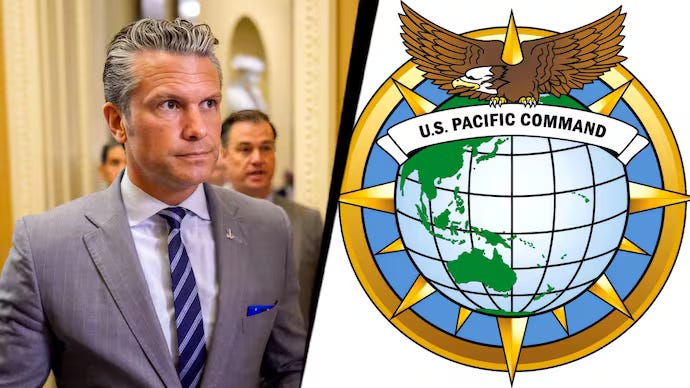
- The Pentagon rebranded Indo-Pacific Command back to Pacific Command in mid-2026, signaling a laser focus on Taiwan Strait defense and prioritizing treaty allies over regional partners like India.
- Trump publicly abandoned the Six Assurances and ruled out U.S. troop intervention in Taiwan, injecting deep uncertainty into American security commitments.
- China is raising the stakes with its newest carrier in the Taiwan Strait, economic coercion against U.S. firms, and a dramatic increase in PLA combatants near Taiwan's shores.
Allies Reassess U.S. Reliability
America’s strategic retreat is forcing treaty allies to question long-held security assumptions as the U.S. pivots from global leadership to transactional defense commitments.
The Pentagon's decision in mid-2026 to revert the Indo-Pacific Command back to Pacific Command signals a deliberate narrowing of the US strategic focus, concentrating primarily on the Taiwan Strait and immediate regional contingencies rather than the broader Indo-Pacific theater. This recalibration prioritizes treaty allies with formal commitments and integrated command structures—namely Japan, Australia, and the Philippines—over partners like India, whose strategic autonomy and reluctance to enter formal alliances limit its operational centrality in Taiwan contingency planning.
The US has expanded its military footprint in the Philippines by increasing bases under the Enhanced Defense Cooperation Agreement from five to nine, effectively transforming the archipelago into a forward hub for strategic posturing against China. However, despite the arrival of advanced systems such as HIMARS and the NMESIS interceptor, these bases remain primarily peacetime presences with limited wartime resilience, serving more as diplomatic tools to tie down Chinese forces rather than as hardened frontline installations.
This strategic narrowing aligns with a broader US shift away from global leadership toward more transactional and selective security commitments, as articulated in the Trump administration’s National Security Strategy declaring, “the days of the United States propping up the entire world order like Atlas are over.” Allies are recalibrating expectations accordingly, with Britain’s House of Lords and public opinion surveys reflecting diminished confidence in US reliability, while Washington increasingly treats partnerships as subscription services measured by immediate returns rather than shared democratic purpose.



Taiwan’s Uncertain Defense Gamble
Taiwan’s military readiness and political unity are fraying as ambiguous U.S. support undermines both defense planning and critical domestic consensus.
Taiwan’s defense posture is fundamentally shaped by its reliance on credible U.S. support, as it cannot independently sustain prolonged resistance against the PLA. This dependency means that Taiwan’s willingness to prepare and fight hinges on clear signals of American commitment, yet under the Trump administration, the shift from strategic ambiguity to outright ambiguity has undermined Taipei’s ability to galvanize resources and maintain a coherent defense strategy.
In response to escalating Chinese military pressure, Taiwan has intensified its internal defense recalibrations through rigorous combat-readiness drills, including the Han Kuang Exercise Number 42 culminating in a live-fire event, and the acquisition of advanced MQ-9B SkyGuardian drones. However, these efforts are complicated by domestic political divisions, as opposition parties have challenged defense procurement bills, reflecting the ongoing struggle to achieve consensus on critical security investments.
Beyond military preparedness, Taiwan is actively cultivating diplomatic ties with partners such as Canada to sustain international support amid Beijing’s economic and political coercion. Despite China’s protests labeling a forthcoming October delegation by the Canada-Taiwan Parliamentary Friendship Group as 'hurtful to ties,' Canada’s commitment remains firm, exemplified by a bilateral investment arrangement in its post-negotiation phase and official statements affirming unchanged Taiwan policy.
Taiwan’s defense strategy increasingly emphasizes affordable and politically palatable capabilities that align with broader U.S. priorities, favoring practical resilience over expensive, specialized weaponry. This pragmatic approach aims to secure sustainable support and maintain the status quo, balancing internal political constraints with the urgent need to deter Chinese aggression effectively.


China’s Double-Edged Pressure Tactics
Beijing is pairing economic coercion with escalating military maneuvers to isolate Taiwan and exploit U.S. retrenchment without triggering open conflict.
China is intensifying its economic coercion as a cornerstone of its strategy to assert regional dominance and pressure Taiwan, leveraging a modern tribute system that Ray Dalio argues is eclipsing U.S. power in Asia. This approach includes pressuring U.S. states and private firms to sever business ties with Taipei, with Chinese lobbyists embedded even at local government levels, effectively weaponizing economic dependencies to isolate Taiwan without resorting to military conflict.
While economic pressure remains paramount, China simultaneously escalates military signaling around Taiwan, demonstrated by the transit of its newest aircraft carrier, the Fujian, through the Taiwan Strait and a dramatic increase in PLA combatants—from one per week to as many as 48 simultaneously—poised to transition from routine exercises to potential blockade or invasion. This dual-use strategy of economic coercion paired with military readiness underscores Beijing’s patient yet assertive posture aimed at eventual reunification without immediate conflict.
China’s broader strategic maneuvers extend beyond Taiwan, encompassing economic sanctions targeting U.S. firms developing alternative supply chains for critical minerals, such as rare earth providers, thereby undermining American efforts to reduce dependency on Chinese resources. Concurrently, China maintains ambiguous military activities in contested areas like Scarborough Shoal, reflecting a multifaceted, low-risk approach designed to expand influence and exploit perceived U.S. retrenchment and distraction, as analysts note Beijing’s preference for long-term, no-regret moves that avoid overt confrontation.
On the global stage, China prefers to consolidate power within existing international institutions rather than spearhead new initiatives, rejecting U.S.-led proposals like the 'Board of Peace' to maintain primacy in bodies such as the United Nations. This cautious diplomacy extends to avoiding direct leadership in contentious conflicts, exemplified by their measured stance on Pakistan, while simultaneously grappling with growing European backlash against its export-driven, low-cost manufacturing model. Meanwhile, Xi Jinping eyes the Trump-Xi summit as a strategic opportunity to secure U.S. concessions on Taiwan, anticipating a rollback of American support for Taiwanese independence.



Summit Resets Taiwan Red Lines
The Trump-Xi summit redefined U.S. security posture by abandoning past commitments, leaving Taiwan’s fate hanging on shifting presidential signals and China’s assertive boundaries.
The Trump-Xi summit in mid-2026 marked a historic recalibration of US-China-Taiwan strategic relations, characterized by the Trump administration’s apparent abandonment of the longstanding Six Assurances and a public refusal to back Taiwan independence. Shao Yuqun highlights this shift as a fundamental departure from prior US commitments, with Trump signaling that 'Taiwan independence means war' and explicitly ruling out US troop intervention, thereby redefining the traditional US defense posture and introducing significant uncertainty into the regional security framework.
This summit fostered a fragile thaw in US-China relations, underpinned by a new strategic framework that acknowledges China as a power of equal standing and shifts the bilateral dynamic from adversarial rivalry to a complex, cooperative competition. Zhou Bo and Li Cheng emphasize that the summit established a 'constructive strategically stable relationship,' with Beijing’s four red lines—including Taiwan and ideological issues—setting clear boundaries to limit confrontation and stabilize ties, signaling a durable pattern of competition and cooperation if war is avoided over the coming decade.
Despite this diplomatic thaw, US policy on Taiwan remains unsettled and fraught with mixed signals, as military officials caution that presidential rhetoric does not necessarily translate into immediate policy changes. Da Wei notes that omissions of Taiwan in key dialogues and reiterations of continuity reflect Trump’s indecision rather than a definitive policy pivot, while China continues to exert intense pressure to prevent Taiwan from becoming heavily armed, underscoring Taiwan’s centrality as the most significant and sensitive issue in US-China relations.
Beyond Taiwan, the summit’s context reveals deep-seated skepticism about China’s broader strategic intentions, including concerns over espionage, influence operations, and the use of economic and educational channels as leverage against the US. Analysts like Tom and Vinnie warn that China’s approach extends beyond mere economic competition, employing business and education as strategic tools, which complicates the fragile stability achieved at the summit and keeps regional and global tensions—especially over oil, technology, and diplomacy—vibrant and impactful across markets and alliances.