USAF fast-tracks AI drones as YFQ-44a hits production milestone
The gist
The US Air Force just fast-tracked AI-powered YFQ-44A drones from live missile tests to early mass production, locking in manned-unmanned teaming as the future of air combat.
What to know
- On July 10, 2026, Anduril's YFQ-44A drone pulled off the first live AIM-120 missile firing by an autonomous US combat drone—under human-in-the-loop control.
- Serial production of the YFQ-44A Fury kicked off ahead of schedule in Ohio, signaling a full-throttle pivot to AI-enabled loyal wingmen designed for distributed sensing, electronic warfare, and strike.
- The USAF plans to field about 150 combat-ready Collaborative Combat Aircraft by 2030, making AI-powered wingmen essential for outpacing peer adversaries and phasing out Cold War-era jets.
AI Drone Fires First Missile
The YFQ-44A autonomously executed a live missile launch under remote human command, showcasing advanced AI-driven targeting and strict human-in-the-loop safeguards.
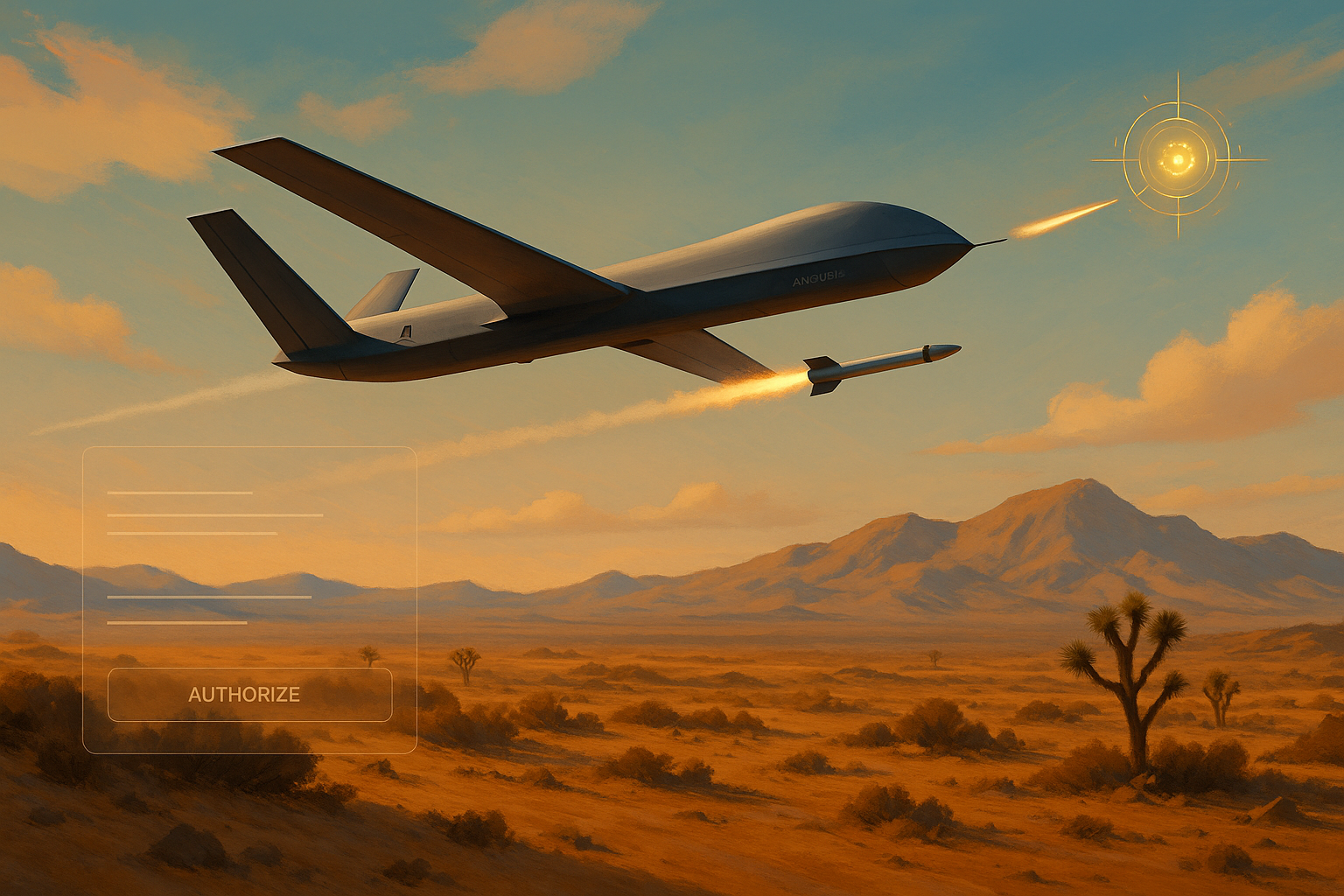
On July 10, 2026, Anduril Industries’ YFQ-44A autonomous combat drone achieved a historic milestone by successfully firing an AIM-120 Advanced Medium-Range Air-to-Air Missile at a simulated target over the Mojave Desert, marking the first live missile release by an American autonomous combat wingman under human-in-the-loop control. This event was the culmination of a deliberate, phased test progression that began earlier in 2026 with inert weapons carriage and data-link integration validation, demonstrating the program’s growing maturity and operational readiness.
The test validated the YFQ-44A’s ability to autonomously execute the weapons employment sequence after receiving a firing command from a remote human operator, who did not have visual confirmation of the target or aircraft during the beyond-line-of-sight engagement. As Mark Shushnar, Anduril’s VP of Autonomous Airpower, explained, the drone’s Lattice software ingested the target track and autonomously managed the sensor-to-shooter data chain, showcasing a sophisticated integration of autonomy within pilot-defined parameters.
Despite the drone’s advanced autonomous flight and strike capabilities, the authority to employ weapons remains strictly under human control, ensuring that every missile launch requires explicit human authorization. This conservative, incremental testing approach mirrors methodologies used for crewed fighter aircraft, prioritizing safety and reliability as the Collaborative Combat Aircraft program transitions toward operational deployment, as emphasized by Gen. Dale White, DRPM for Critical Major Weapon Systems.
The YFQ-44A carries its armament externally on two hardpoints beneath each wing, and this live-fire test represents a critical evolution from earlier flights that only carried inert weapons. Successfully hitting a digital target with a live AIM-120 missile underlines the drone’s readiness to integrate into future manned-unmanned teaming scenarios within the US Air Force’s Collaborative Combat Aircraft framework.

Legacy Jets Meet AI Autonomy
The VENOM Autonomy Kit transforms F-16s into AI testbeds, accelerating manned-unmanned teaming and fueling a global race for autonomous air combat supremacy.
In July 2026, the U.S. Air Force and DARPA marked a pivotal advancement in autonomous combat aviation by successfully flying a retrofitted F-16 Fighting Falcon equipped with the VENOM Autonomy Kit, which integrates dedicated computing hardware and advanced sensors without altering the jet’s core flight software. This innovation enables rapid scaling of AI-enabled autonomous flight capabilities on legacy platforms, transitioning from controlled demonstrations under DARPA’s Air Combat Evolution program to operational testbeds supporting continuous AI experimentation and tactical decision-making under a human-on-the-loop model, where pilots supervise and can intervene during AI-controlled flight.
The VENOM program is a cornerstone of DARPA’s broader Artificial Intelligence Reinforcements (AIR) initiative, aiming to field fleets of autonomous aircraft commanded by human pilots for beyond-visual-range combat, reflecting a strategic shift toward trusted manned-unmanned teaming. This approach is mirrored across the defense industry, where programs like Anduril’s YFQ-44A and General Atomics’ Dark Merlin—expected to enter service by 2029—are designed to seamlessly integrate with fifth-generation fighters, enhancing combat effectiveness through extensive autonomous capabilities and fostering competition among major defense firms and startups vying for future procurement contracts.
Globally, the race to develop AI-enabled autonomous combat aircraft is intensifying, with nations such as China, Russia, Germany, and Australia deploying platforms like the GJ-11 ‘Sharp Sword’ and S-70 Okhotnik, underscoring a broad defense industry competition that extends beyond the U.S. Meanwhile, companies like SHIELD AI are advancing autonomy through their Hivemind platform, emphasizing scalable, modular AI systems capable of independent operation in contested environments with potential communication loss, while maintaining human oversight to ensure collaborative decision-making and operational trustworthiness.
To avoid vendor lock-in and promote rapid integration of cutting-edge AI technologies, the U.S. Air Force is implementing an Autonomy Government Reference Architecture (AGRA) that ensures modularity, transparency, and flexibility in AI pilot systems. This framework supports the evolving landscape of autonomous combat aircraft by allowing seamless switching between different AI pilots and fostering a competitive ecosystem where the best-of-breed autonomy solutions can be deployed swiftly to maintain air dominance in future contested battlespaces.



Warfighters Test AI Wingmen
USAF operators are rapidly shaping new tactics and doctrine by integrating loyal wingman drones into real-world exercises, shifting pilots from direct control to mission command roles.
From July 20-24, 2026, the USAF’s Collaborative Combat Aircraft Experimental Operations Unit (EOU) conducted an Agile Combat Employment (ACE) exercise at Creech AFB, Nevada, integrating multiple loyal wingman platforms such as the YFQ-42A and YFQ-44A under direct military operator control. This exercise marked a deliberate shift from traditional test environments to operational settings, emphasizing rapid feedback and adaptation by placing these systems directly in the hands of warfighters, as highlighted by Lt. Col. Matthew Jensen, commander of the EOU.
The USAF is leveraging these operational exercises not merely to evaluate platform performance but to accelerate doctrinal development that encompasses autonomous system integration, human-machine teaming, and Agile Combat Employment from dispersed bases. By involving units like the Air Force Operational Test and Evaluation Center (AFOTEC), the service aims to compress the timeline for introducing new CCA capabilities, gathering real-world data to refine tactics and employment concepts that will underpin the planned fleet of approximately 1,000 CCAs.
This operational integration reflects a broader doctrinal evolution in which pilots transition from direct operators to commanders who direct their assigned drone counterparts in complex missions. The semi-autonomous CCAs are designed to execute mission-oriented tasks under pilot direction, enhancing manned-unmanned teaming and combat effectiveness, and signaling a strategic move to expand sensor networks and strike options alongside 300 NGAD fighters and over 200 F-35s.
Fury Drone Enters Mass Production
The YFQ-44A’s early production launch signals a strategic leap toward AI-powered air fleets, forcing a pivot from aging manned jets to scalable, software-driven combat systems.
The YFQ-44A Fury’s transition into serial production at Arsenal-1 in Ohio marks a pivotal moment in the US Air Force’s strategic pivot toward autonomous combat aircraft. Emerging just 557 days after Anduril announced Arsenal-1 and ramping production 126 days prior to schedule, this rapid industrialization underscores a new era where software-defined, modular manufacturing enables swift regeneration of combat power. Designed as a semi-autonomous loyal wingman, the Fury enhances distributed sensor, weapon, and electronic warfare capabilities, allowing manned fighters to operate farther from lethal zones and effectively counter modern anti-access and area-denial threats.
This production milestone is set against a broader strategic imperative: the accelerating race to integrate AI-driven unmanned systems into warfare, where autonomous platforms like the YFQ-44A provide a decisive competitive edge. As analysts emphasize, "if you are using AI, you're going to grow and take market share," a principle that applies equally on the battlefield, where autonomous drones perform critical roles such as target interception and disabling enemy air defenses to protect manned assets. The US Air Force’s ambitious plan to field approximately 150 combat-capable Collaborative Combat Aircraft by 2030, with long-term visions approaching 1,000 robotic wingmen, reflects a recognition that future air superiority hinges on manned-unmanned teaming to outpace peer adversaries like China.
The strategic context demands a fundamental shift away from legacy investments in conventional manned platforms toward more efficient, AI-enabled autonomous systems. Experts warn that continued reliance on Cold War-era force structures risks diverting critical funding and leaving the US and its allies vulnerable to adversaries who rapidly embrace unmanned, AI-controlled weapons. By crunching massive data volumes and executing rapid strikes without onboard humans, these autonomous systems promise to redefine combat dynamics, making accelerated development and deployment of platforms like the Fury not just advantageous but essential to maintaining global military leadership.