Vertical AI surges ahead, outpacing generic rivals in SaaS
The gist
Vertical AI is leaving generic rivals in the dust, powering regulated SaaS sectors with domain-specific automation, massive productivity gains, and valuations that skyrocket past industry norms.
What to know
- By late 2025, AI platforms like Harvey AI and Spellbook unlocked 50-80% productivity boosts in legal and finance workflows—without ripping out legacy systems.
- By mid-2026, companies like Casca and New Silver used AI to automate up to 90% of manual tasks, slashing loan and mortgage processing times to under 20 days.
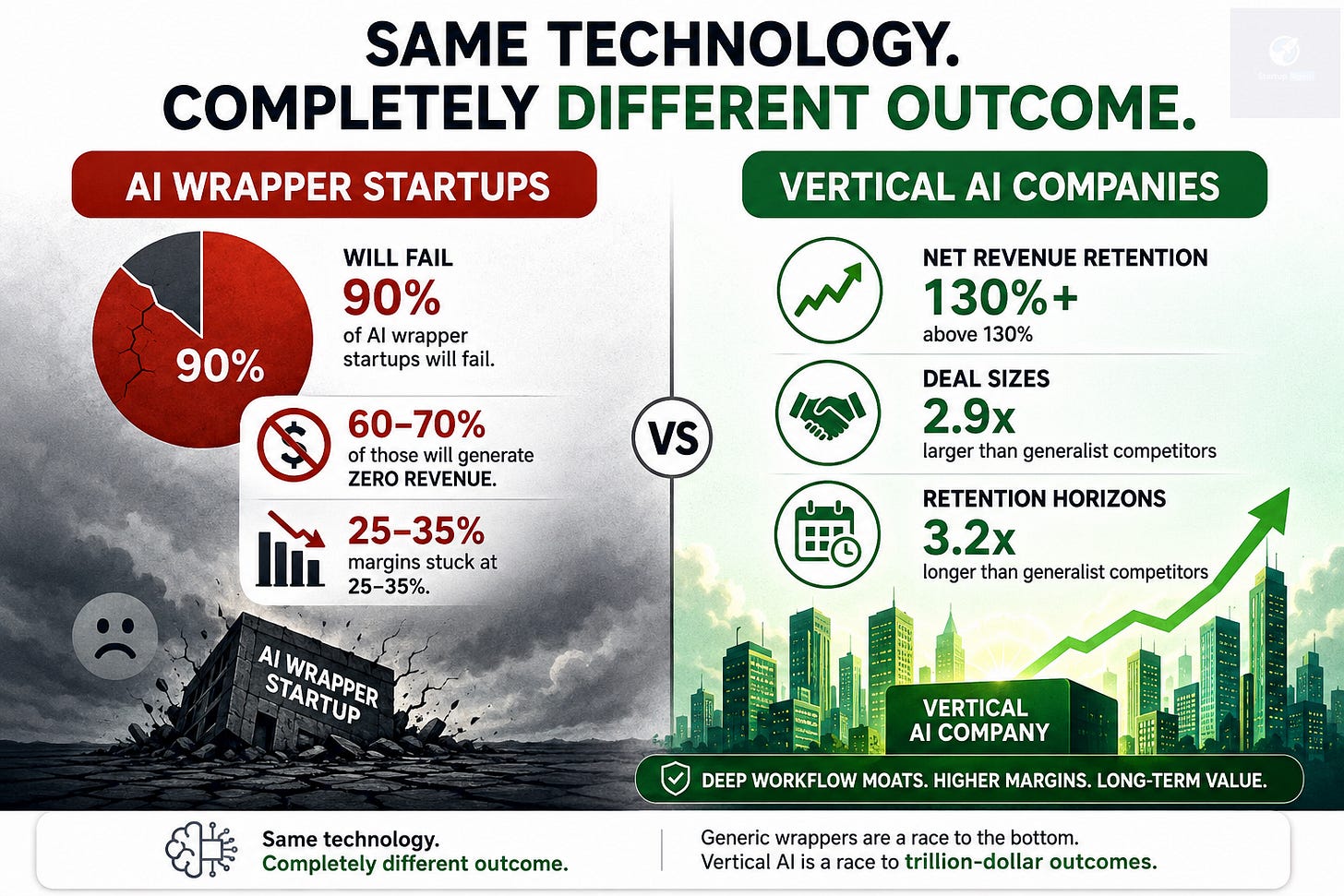
- Vertical AI firms now boast net revenue retention above 130% and ARR multiples of 15x-20x—triple the rates of generic AI tools—reshaping the SaaS landscape.
AI Wedges Crack Old Markets
Vertical AI tools are smashing through decades of digital inertia in regulated industries by embedding deeply into core workflows and rapidly expanding from niche pain points to full platforms.
By late 2025, industry-specific generative AI tools emerged as crucial wedge products within vertical SaaS, particularly in heavily regulated sectors like legal and finance, where digitization had stalled for decades. These AI solutions, exemplified by Harvey AI and Spellbook, deliver immediate, domain-aware value by drastically reducing time-to-value from months to minutes through deep understanding of workflows such as legal research and contract drafting. Unlike generic horizontal AI, these specialized tools generate productivity gains of 50-80% in narrow workflows, making them indispensable rather than optional, and enabling firms to overcome entrenched adoption barriers without replacing entire legacy systems.
The wedge product strategy follows a phased evolution beginning with high-pain workflow AI tools in the first year, progressing to data capture and adjacent workflow expansions in the second year, and culminating in broader platform growth with embedded fintech and marketplace features by year three. This approach is illustrated by companies like Harvey AI, which started as a legal assistant and is now evolving into full legal workflow infrastructure, and Abridge, which expanded from clinical documentation to decision support. Such natural expansion paths demonstrate how owning the AI layer in a specific workflow creates a foundation for comprehensive vertical SaaS platforms.
Real-world case studies from early 2026 highlight how AI wedge products are breaking ground in traditionally low-tech and complex regulated verticals beyond legal, including tire retail and compliance automation. For instance, Supio’s AI extracts document schemas enabling legal firms to pay premiums for improved workflows, while Agentic AI’s voice agents streamline tire shop operations by connecting wholesalers and retailers. Similarly, startups like Delve automate compliance tasks and have rapidly gained traction, ranking highly on Andreessen Horowitz’s AI startup spending report, underscoring the growing market recognition and timing advantage of AI wedge products coinciding with advancements like GPT-4.
Despite the promise of AI wedge products, early enterprise adoption in regulated industries remains challenging and protracted, often requiring extensive iterative development and strategic go-to-market approaches. Spellbook’s journey, involving over 100 product experiments before finding product-market fit and scaling in 2022, exemplifies this, as does a compliance startup’s eight-month effort to secure its first enterprise customer. Notably, Spellbook’s bottoms-up adoption strategy contrasts with the typical top-down legal AI sales model, reflecting innovative pathways to overcome resistance and capture a share of the massive $30 trillion legal contract market.






Systems of Action Take Over
Vertical SaaS is shifting from passive data storage to AI-powered platforms that autonomously execute critical, end-to-end industry workflows, creating new stickiness through decision-layer context.
By early 2026, vertical SaaS is undergoing a fundamental transformation from traditional 'systems of record'—which merely store historical data—to AI-powered 'systems of action' that govern and autonomously execute complex workflows. As Scott Hoke of AQL Growth explains, while systems of record capture what happened, systems of action decide what happens next and then do it, fundamentally shifting vertical SaaS from passive repositories to active workflow enablers where critical tasks like claims submission, revenue recognition, and compliance enforcement are finalized.
This evolution is driven by the erosion of traditional moats based on data stickiness and switching costs, as AI now enables seamless data harmonization and migration, exemplified by Nic's personal experience of effortlessly switching internal systems of record. Consequently, vertical SaaS providers are pivoting towards building defensibility through proprietary 'context graphs' or 'decision layers'—unique data layers that capture not only what happened but why decisions were made within workflows. This accumulated domain-specific context forms a new, more resilient switching cost that enhances customer stickiness beyond mere data storage.
AI-driven systems of action unlock transformative automation capabilities that surpass earlier notification-based tools by autonomously executing multi-step processes end-to-end. For instance, as Luke describes, AI can create and send invoices, run multi-step follow-up cadences to secure payment, and reconcile transactions back to the general ledger without human intervention. This seamless orchestration of workflows not only streamlines operations but also generates rich, actionable data that serves as a sticky foundation for training AI models to anticipate and autonomously perform subsequent steps, thereby deepening customer retention beyond traditional CRM data reliance.
Agentic AI Drives Compliance
AI agents and user-controlled playbooks are automating complex, regulated tasks in sectors like legal and healthcare, boosting ROI and accuracy while keeping humans in the loop for accountability.
By early 2026, AI capabilities in regulated vertical SaaS platforms had matured to integrate agentic intelligence and document intelligence, enabling comprehensive automation and compliance across complex workflows. Jason’s platform for tire shops exemplified this evolution by connecting wholesalers, distributors, and retailers with AI-powered software that replaced legacy processes, while Jerry Zwo’s work at Supio demonstrated how schema extraction from documents unlocked software adoption in traditionally software-averse sectors like legal and medical records. This integration not only automated labor-intensive tasks but also significantly boosted ROI, with voice agents trained on schema capable of replacing front desk labor costing up to $75,000 annually and doubling average revenue per user from $10,000–$15,000 to over $25,000.
Legal AI platforms such as Harvey and CoCounsel illustrate the deepening integration of AI from simple assistants to full industry infrastructure coordinating multiple specialized AI agents alongside human reviewers. As Harvey’s CEO described in March 2026, the platform evolved from a copilot to an orchestrator of multi-party workflows, enabling AI agents to perform discrete legal tasks with human-in-the-loop oversight, a model rapidly embraced by Fortune 500 companies seeking transformative efficiency gains. CoCounsel’s transition from Retrieval-Augmented Generation to an agentic AI brain tightly integrated with Westlaw Practical Law further exemplifies this trend, combining complex legal content with rigorous responsible AI practices including hallucination and bias detection to ensure market readiness and compliance.
The rise of user-controlled playbooks and customizable AI 'skills' has empowered regulated industries to tailor AI workflows precisely to their compliance needs, as seen in LexisNexis’s platform allowing users to upload text-based instructions that guide AI agents through complex legal tasks. This paradigm shift is echoed in Snowflake’s contract review solution, where auditors maintain full control over evolving definitions of 'nonstandard' clauses via an editable playbook stored in a governed Snowflake table, enabling a 70% reduction in review time by automating exhaustive document reading while preserving human judgment. Such innovations reflect a broader movement toward AI systems that not only parse and classify documents with confidence scores and natural-language explanations but also continuously learn from human corrections to enhance accuracy over time.
Across regulated sectors like mortgage lending, legal, and real estate finance, AI-powered document intelligence engines have become foundational to end-to-end workflow automation, dramatically accelerating processes and improving compliance. Built Technologies’ deployment of an AI engine on AWS processes over 250 complex document types with over 95% confidence, enabling agentic AI products throughout the real estate lifecycle. Similarly, AI integration in mortgage lending now unifies front and back office operations to analyze documents and communicate with borrowers in near real-time, reducing document turnaround from days to minutes. Legal platforms like SmartAdvocate and Fogel Law Group have embedded AI natively within their architectures to provide seamless automation across intake, document processing, and case intelligence, supporting multi-tenant, scalable, and compliant workflows that eliminate the need for disparate tools and infrastructure.


Legacy Cores Replaced by AI
AI-native platforms are leapfrogging legacy systems in finance and legal, delivering 10x faster processing, automating up to 90% of manual tasks, and making compliance scalable for the first time.
Casca's AI-native loan origination platform exemplifies the transformative potential of fully replacing legacy core systems in specialized verticals, achieving a staggering 10x faster processing than fintech peers and automating 90% of manual tasks. Founded in 2023, Casca’s rapid scaling and investor confidence—evidenced by a $29M Series A led by Canapi Ventures—underscore how deeply embedding AI into regulated workflows can drive substantial efficiency, compliance improvements, and market growth.
Early adoption of large language models like GPT-4 enabled startups to automate complex compliance tasks previously reliant on large human teams, as seen with the startup that replaced IA’s outsourced moderators, improving efficiency by an order of magnitude. Despite an arduous eight-month sales cycle to land their first enterprise customer, this milestone validated the viability of AI-native platforms fully supplanting legacy human workflows in regulated environments.
In the legal vertical, AI-powered platforms such as Litera’s Kira and Snowflake’s agentic contract review have revolutionized workflows by drastically reducing review times—up to 70% at Snowflake—and transforming legal teams from reactive reviewers into strategic partners. These platforms combine deep domain expertise, continuous learning from user feedback, and user-managed playbooks that allow auditors and lawyers to maintain control and compliance while scaling operations efficiently across thousands of contracts.
Real estate and mortgage lending have seen rapid scaling of AI-native underwriting platforms, with New Silver processing loan documents in under a minute and Dark Matter onboarding large lenders to replace fragmented legacy systems with holistic end-to-end AI solutions. These platforms not only accelerate loan evaluations and compress mortgage timelines—from application to funding in less than 20 days—but also enable scalable growth without proportional increases in headcount, ensuring consistent underwriting standards and real-time client feedback to reduce delays in time-sensitive deals.

AI-Native Platforms Redefine Legal
Legal tech leaders are rebuilding their platforms from the ground up around AI, using vectorized data and modular architectures to automate unstructured workflows while meeting stringent compliance demands.
By early 2026, pioneering legal tech firms like Filevine radically reengineered their platforms to become AI-native, shifting from manual data entry to automated ingestion through vectorized databases that seamlessly handle unstructured data across diverse formats. This architectural overhaul reflects a broader industry move away from traditional case management systems toward AI-driven legal operating systems, as Filevine’s leadership emphasized the need to reimagine lawyer interactions with AI-native platforms rather than legacy workflows.
The integration of AI within regulated workflows demands not only technical innovation but also organizational transformation, as demonstrated by the Lawyers On Demand and Wordsmith partnership. Embedding AI at scale within managed delivery models allows teams to maintain existing operational rhythms while enhancing efficiency and compliance. Nigel Rea of LOD highlights the critical role of combining expert professionals, governance frameworks, and AI-native platforms to ensure AI deployment is practical, reliable, and governed—an approach validated by measurable improvements in contract handling and turnaround times during pilot programs.
In highly regulated sectors like real estate finance and SBA lending, companies such as Built Technologies and Fogel Law Group have implemented multi-tenant, modular AI architectures on cloud platforms like AWS and IBM watsonx to securely isolate client data while enabling scalable, parallel processing of complex document workflows. These platforms transcend traditional OCR by achieving over 95% confidence in context-dependent extraction, managing nested tables, embedded imagery, and domain-specific language, thereby meeting stringent compliance demands. Moreover, agile team structures foster continuous collaboration between technical experts and industry specialists, enabling rapid iteration and refinement of AI-driven document processors.
The shift in enterprise AI bottlenecks from model performance to document-layer data management has necessitated comprehensive transformations in data governance, secure multi-tenant environments, and workflow integration. IDC forecasts that by 2027, nearly half of top Asia-Pacific organizations will adopt scale-out storage and unified data management to handle expanding unstructured datasets under sovereignty constraints. Platforms like IBM’s Docling and Fogel Law Group’s File Review Agent exemplify how preserving document context—such as hierarchy, tables, and reading order—combined with embedded human validation and control-function reviews, ensures regulatory compliance and operational trustworthiness. These managed SaaS offerings reduce operational overhead while enabling agile updates to workflows through relational databases, allowing legal teams to adapt rapidly without rebuilding core applications.

Vertical AI Becomes the Moat
Specialized AI deeply embedded in domain workflows is driving explosive financial performance, creating defensible market positions, and capturing a growing share of the $450B SaaS opportunity.
The evolution of AI platforms is poised to follow a familiar trajectory seen in previous technological shifts such as the internet and mobile eras, where dominant horizontal platforms eventually gave way to specialized vertical solutions. As Danny articulates, this 'third platform shift' reflects a growing preference for AI products tailored to specific workflows rather than broad, generic tools like ChatGPT or Claude. Despite the allure of customizable AI platforms, the market overwhelmingly favors vertical AI products that address precise problems, underscoring a fundamental realignment in how AI value is delivered and captured.
By mid-2026, the market dynamics clearly favor vertical AI solutions, which demonstrate superior financial performance with net revenue retention rates exceeding 130%, deal sizes nearly three times larger, and retention horizons over three times longer than their generic counterparts. This robust performance translates into valuation multiples soaring between 15x and 20x ARR for vertical AI companies leveraging proprietary workflow data, dwarfing the 3x to 4x multiples typical of generic AI wrappers. A16z projects this shift will reshape 30 to 40% of the $450 billion global vertical SaaS market by 2028, fueled by rapid enterprise adoption—already evidenced by 51% of enterprises running AI agents in production as of Q2 2026.
For founders and investors, the imperative is clear: building AI systems deeply embedded within regulated, domain-specific workflows creates defensible moats that foundation model updates cannot easily erode. As one founder highlights, developing 'the only AI system that understands solar permit workflows across all 50 states' exemplifies how proprietary workflow expertise—not just the underlying AI model—constitutes lasting competitive advantage. This strategic focus on vertical integration is essential to avoid commoditization and to capture the trillion-dollar opportunity emerging from the vertical AI revolution.