Watermarks wobble: AI labeling faces reality check as cropping exposes industry gaps
The gist
Invisible watermarks meant to flag AI-generated content are crumbling under basic edits, exposing major cracks in the industry's plan for digital authenticity.
What to know
- Google’s SynthID and Meta’s Content Seal have watermarked over 100 billion assets since 2025, but routine cropping wipes out detection in over half of Meta’s AI images.
- Watermarking alone is no silver bullet—cropping, resizing, or compressing images can easily break these invisible labels, prompting experts to demand multilayered verification.
- Industry leaders and privacy experts now call for a fusion of cryptographic proofs, watermarking, and passive AI detection to build a trust infrastructure that actually works.
SynthID’s Industry Takeover
Google’s SynthID watermarking has become the backbone of AI content verification, driving cross-industry alliances and shifting the value of digital content from creation to credibility.
By late 2025, Google pioneered the integration of SynthID watermarking technology to label AI-generated ads across its platforms including Search, YouTube, and Discover, embedding invisible watermarks detectable via its Gemini app. This initiative not only automatically tags ads created with Google's generative AI tools with an “AI-created” label and detailed disclosures in My Ad Center but also accommodates third-party AI tool users through self-declaration, aligning with local regulatory requirements to bolster transparency and user trust.
By mid-2026, SynthID’s adoption had expanded significantly, with over 100 billion AI-generated images, videos, and audio assets watermarked, embraced by industry leaders such as OpenAI, Nvidia, Kakao, and Lean Labs. This widespread uptake underscores the growing consensus that watermarking and cryptographic proof are indispensable for verifying authenticity and establishing trust in an era where AI content creation is increasingly cheap and prolific, shifting the value proposition toward verification and transparency.
Kakao’s adoption of Google DeepMind’s SynthID watermarking technology exemplifies the industry’s collaborative push toward transparent AI content governance. By embedding invisible watermarks into AI-generated content without altering its appearance, Kakao enhances traceability and credibility, enabling seamless verification that content is AI-produced. This partnership reflects a broader vision where watermarking infrastructure not only mitigates misinformation but also fosters innovative models of content governance and societal trust.

Meta’s Watermark Weakness
Meta’s invisible Content Seal watermark collapses under simple edits like cropping, revealing fragmentation and technical limits in the race for reliable AI provenance.
Meta’s Content Seal watermark, launched in mid-2026 exclusively for its Muse Image AI model, initially demonstrated strong detection capabilities by accurately identifying all original AI-generated images in independent tests. However, the system revealed a critical vulnerability to common image manipulations, particularly cropping, which caused the detector to miss approximately 55% of AI images once cropped to about one third to one half of their original size. Meta itself acknowledged that heavy cropping can degrade or even erase the watermark signal, highlighting the ongoing challenge of ensuring watermark durability amid routine edits like resizing and compression that frequently occur in online sharing.
The Content Seal watermark represents a strategic shift from visible logos to a proprietary invisible watermarking system, but its current implementation is limited in scope and interoperability. It is confined to Meta’s Muse Image outputs and incompatible with other emerging watermarking standards such as Google’s SynthID and the C2PA framework, restricting its utility as a universal AI provenance tool. Detection is also constrained by Meta’s standalone web interface, which imposes daily usage limits and cannot verify images generated by older Meta AI tools, underscoring the fragmented landscape of AI content verification technologies.
Meta’s experience with Content Seal underscores a broader industry-wide dilemma: watermark-based AI detection methods, while valuable, face inherent limitations because any modification—cropping, resizing, compression—can weaken or remove the embedded signals that detectors rely on. Experts like Siwei Lyu emphasize that watermarking remains effective only when the embedded signal is intact, and Meta’s ongoing preview status reflects the technical hurdles in creating robust, tamper-resistant provenance systems. This vulnerability has prompted calls from Meta’s Oversight Board and other stakeholders for stronger, multilayered detection strategies that combine watermarking with complementary approaches to better combat deceptive AI-generated content.

Watermarks vs. Real-World Edits
Watermark-based detection fails under everyday image tweaks, prompting experts to push for hybrid systems that combine embedded signals with robust content analysis.
Watermark-based AI content detection systems, exemplified by Meta's Content Seal, face significant challenges in real-world applications due to their vulnerability to common image edits like cropping, resizing, and compression. Reuters testing revealed that Meta's detector failed to verify 55% of cropped AI-generated images from its own Muse Image model, a shortfall Meta itself acknowledged by conceding that heavy cropping can cause watermark loss. This limitation is not unique to Meta; major players such as Google and OpenAI have similarly expressed concerns about watermarking's fragility against typical social media manipulations, underscoring the method's practical constraints.
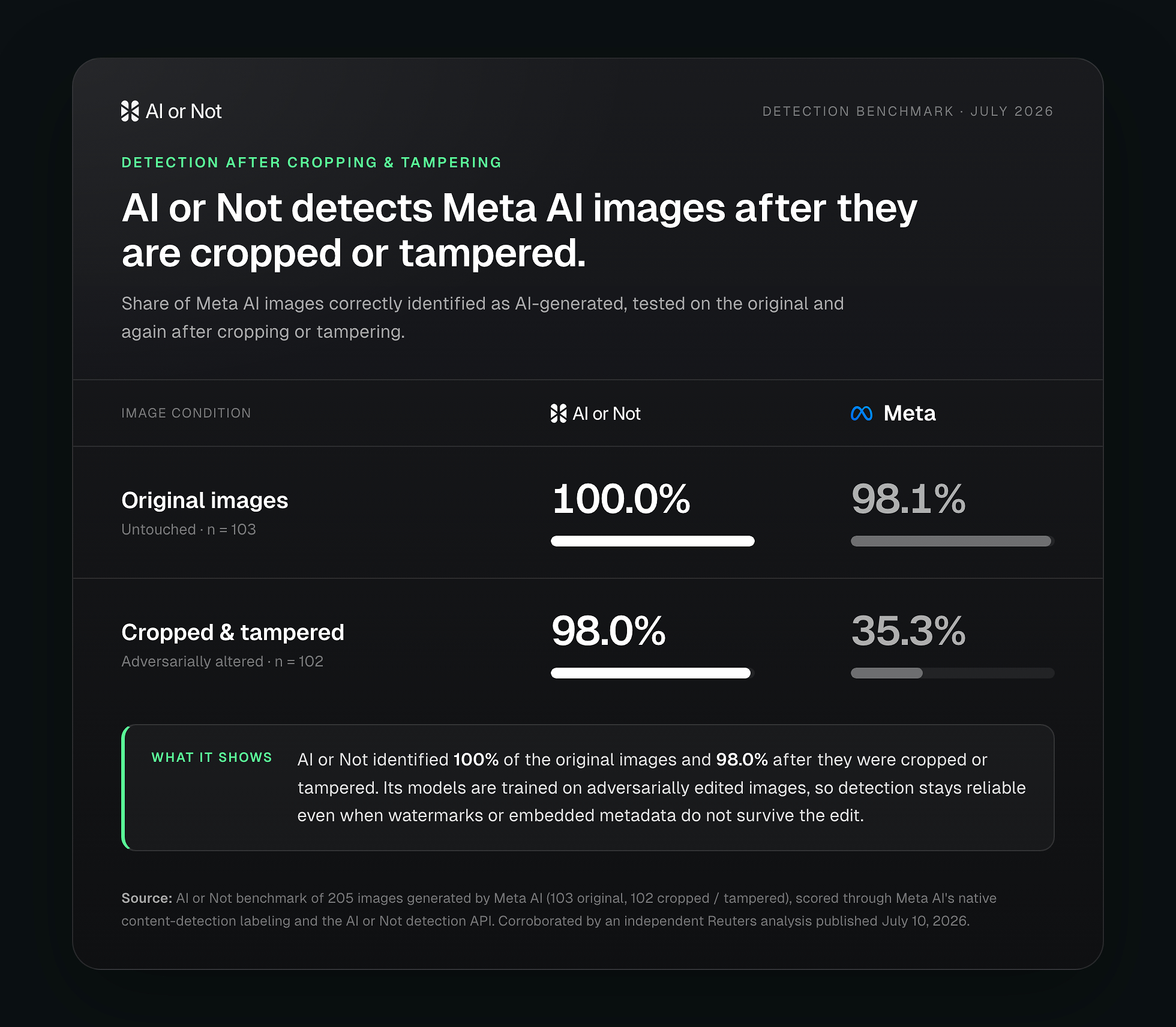
Recognizing these inherent weaknesses, industry experts and oversight bodies advocate for a multilayered approach that supplements watermarking with complementary detection methods analyzing intrinsic signals within AI-generated content. Meta’s Oversight Board has urged investment in more robust tools to counter deceptive synthetic media, while researchers like Siwei Lyu emphasize that any alteration weakening the embedded watermark diminishes effectiveness, necessitating alternative strategies. Technologies such as AI or Not’s intrinsic signal detection demonstrate this potential by maintaining near-perfect accuracy—98% even after images are cropped or tampered with—highlighting the resilience of content-based analysis over sole reliance on embedded watermarks.
Despite its shortcomings, watermarking remains a meaningful advance in promoting AI content transparency, serving as a foundational layer within a broader detection ecosystem. Experts like Sarah Barrington liken it to preventive security measures that, while not foolproof, significantly improve detection rates from zero to as high as 90% in some cases. However, current implementations such as Meta’s Content Seal face additional hurdles including incompatibility with other provenance standards like Google’s SynthID and C2PA, limited accessibility, and inability to detect outputs from older AI tools, which collectively constrain its widespread adoption and effectiveness.
The cumulative evidence from independent analyses and expert commentary makes clear that no single detection method, including watermarking, can reliably identify AI-generated content under the diverse and adversarial conditions of real-world use. This consensus drives the imperative for integrated detection frameworks combining watermarking with intrinsic signal analysis and other emerging technologies to robustly address the evolving challenges posed by synthetic media. As the landscape of AI-generated content grows more complex, such multilayered strategies will be essential to maintain trust and authenticity online.

Building a Multilayered Trust Stack
Privacy leaders call for cryptographic metadata, invisible watermarks, and passive detection to create an interoperable, machine-readable AI transparency infrastructure.
By mid-2026, experts from IAPP underscored that no single technical solution suffices to ensure comprehensive AI transparency, given persistent tradeoffs involving effectiveness, interoperability, privacy, accessibility, robustness, and cost. To overcome these limitations, they advocate for a multilayered framework that synergistically combines cryptographic provenance metadata, invisible watermarking, and passive detection tools. This integrated approach not only compensates for the weaknesses inherent in individual methods but also lays the foundation for a reliable, interoperable, and enforceable transparency infrastructure capable of adapting across diverse AI contexts.
The IAPP analysis further highlights a critical evolution needed in AI transparency—from mere labeling of AI-generated content to embedding machine-readable governance signals within that content. Unlike simple labels that merely indicate 'This content was AI-generated,' these governance signals can instruct AI systems on permissible data usage, effectively bridging a crucial infrastructure gap in the AI ecosystem. This shift toward machine-readable metadata promises to empower platforms and AI models alike with nuanced control and compliance capabilities, moving beyond surface-level transparency to actionable data governance.
Trust Becomes the New Currency
With AI-generated content surging, authenticity verification powered by watermarking and cryptographic proofs is redefining digital trust and reshaping the information economy.
As AI-generated content floods the digital landscape with unprecedented volume and affordability, the intrinsic value of content is rapidly shifting from mere creation to authenticity verification. By early 2026, experts emphasized that establishing trust through cryptographic proofs and watermarking technologies like Google's SynthID has become essential, effectively creating a trust infrastructure that underpins the new content economy. This shift reflects a broader industry consensus, with major players such as OpenAI, Nvidia, Cacao, and Lean Labs spearheading self-regulation efforts through the adoption of watermarking standards, especially as governmental regulations lag behind the fast-evolving AI landscape.
Beyond individual content verification, robust AI provenance enabled by watermarking and credentialing technologies promises to reshape societal interactions with digital media by significantly curbing misinformation and enabling innovative content governance models. Google's SynthID exemplifies this transformative potential, offering a scalable trust infrastructure that not only fosters abundance in content creation but also empowers platforms and users to discern authenticity reliably. This evolution signals a paradigm shift where trust and provenance become foundational pillars, potentially redefining how information ecosystems operate in the AI era.