Wells fargo bets on dual track in tokenized deposit race
The gist
Wells Fargo is doubling down on tokenized deposits, launching its own digital platform while teaming up with 25 major banks to battle stablecoins for control of the digital dollar.
What to know
- Wells Fargo will roll out its proprietary tokenized deposit platform for cross-border corporate payments in 2026, starting with US dollar to British pound transactions.
- A 25-bank consortium led by The Clearing House aims for a mid-2027 launch of a shared, interoperable network offering 24/7 instant settlement—positioning banks as the FDIC-insured, regulated answer to stablecoins.
- With up to $6.6 trillion in deposits at stake and new stablecoin rules arriving in 2027, banks’ tokenized deposits are racing to achieve scale and interoperability before stablecoin rails dominate.
Banks’ Dual-Track Gamble
Wells Fargo is hedging its bets by building both a proprietary tokenized deposit platform for programmable cross-border payments and joining a consortium to solve the critical challenge of interbank interoperability.
Wells Fargo exemplifies the banking sector’s dual-track strategy by simultaneously launching a proprietary tokenized deposit platform for corporate clients and collaborating with The Clearing House consortium to develop a shared interoperable network. The proprietary platform, set to launch in fall 2026, focuses initially on US dollar to British pound transactions, offering programmable payments with smart contracts and conditional logic that automate complex corporate treasury workflows while preserving FDIC insurance and regulatory protections. Meanwhile, the consortium-led network, targeting a mid-2027 rollout, aims to replicate the scale and systemic integration of traditional interbank settlement systems like CHIPS on a distributed ledger, addressing the critical challenge of interbank interoperability that proprietary platforms alone cannot solve.
This dual-track approach reflects banks’ strategic balancing act between rapid innovation and systemic integration amid competitive pressures from stablecoin consortia such as Open USD, which launched ahead of major banks’ digital dollar initiatives. As James Wester highlights, tokenized deposits serve as a direct response to stablecoins, but their utility hinges on interoperability; without it, deposit tokens risk limited adoption. Wells Fargo CEO Charlie Scharf acknowledges that while client curiosity about tokenization is high, tangible benefits are still emerging, underscoring an ongoing phase of market education and experimentation as banks hedge their bets between proprietary speed and consortium-driven standards.
Wells Fargo’s proprietary tokenized deposit platform is designed to meet immediate client demands for faster, programmable, and cross-border corporate payments, enabling 24/7 settlement and automation of payment conditions tied to invoices or delivery milestones. However, recognizing that corporate funds frequently move across multiple banks, Wells Fargo and its peers see consortium collaboration through The Clearing House as essential to achieving broader interbank interoperability, regulatory compliance, and systemic scale. This approach allows banks to maintain control over payment rails and corporate cash flows within regulated channels, positioning tokenized deposits as a bank-backed alternative to stablecoins while modernizing payment infrastructure.
Consortium’s Interoperability Edge
A 25-bank alliance led by The Clearing House is racing to launch an interoperable network that fuses blockchain speed with traditional bank trust, directly targeting stablecoins’ network effects.
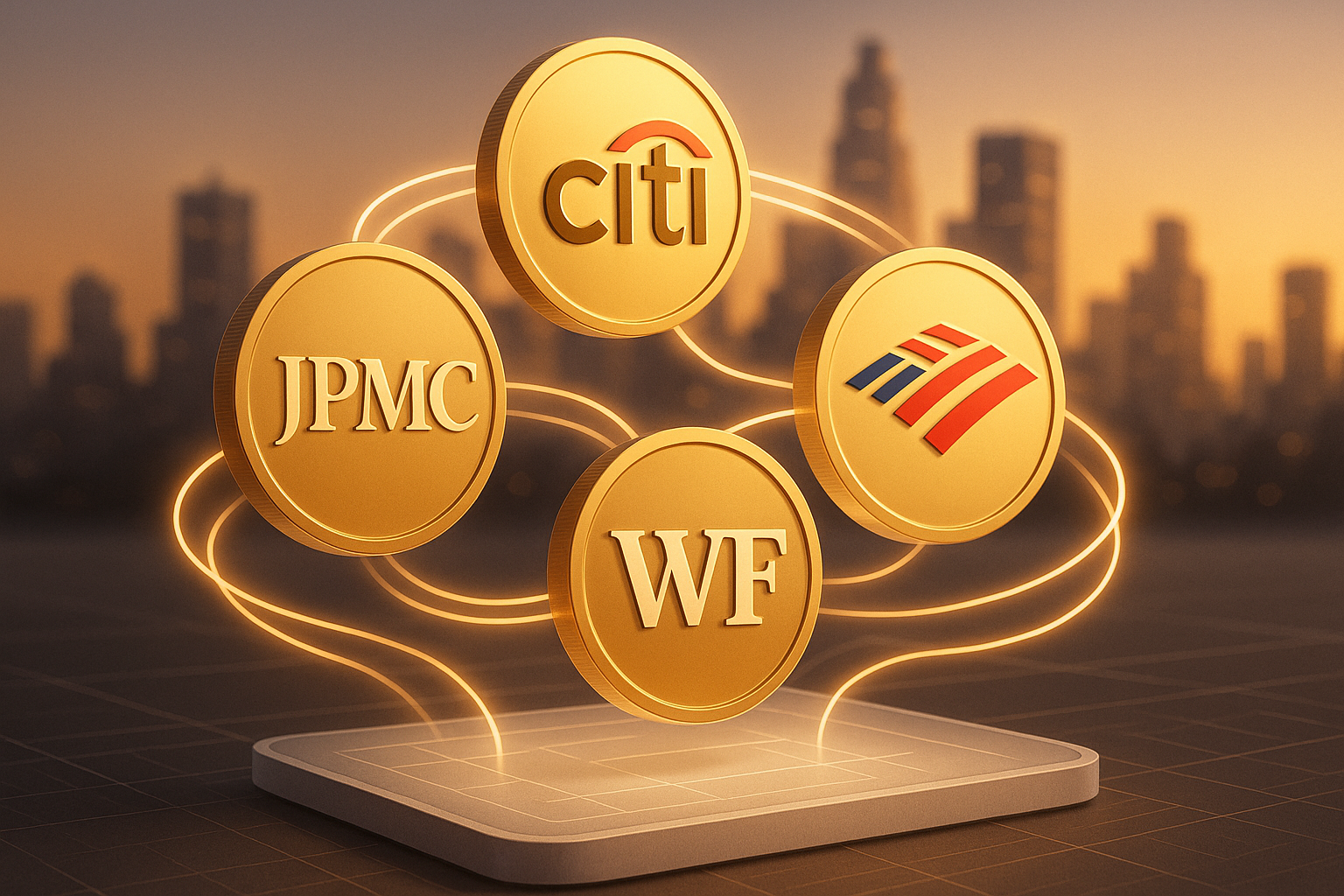
The Clearing House consortium, comprising 25 major U.S. banks including JPMorgan Chase, Citigroup, Bank of America, and Wells Fargo, is spearheading the development of a shared tokenized deposit network targeting a first half 2027 launch. This interoperable platform aims to enable 24/7 instant settlement of tokenized deposits between participating banks, effectively creating an alternative payment rail that transcends traditional Federal Reserve wire system hours. By allowing each bank to issue its own interoperable deposit tokens, the network facilitates seamless movement of corporate treasury funds across institutions, enhancing liquidity and programmability while leveraging The Clearing House’s existing RTP real-time payments infrastructure as a neutral coordination layer.
Unlike stablecoins, tokenized deposits remain liabilities of their issuing banks and inherit existing regulatory frameworks such as FDIC insurance and capital requirements, eliminating the need for new legislation. This regulatory alignment positions bank-issued tokenized deposits as a compliant, interest-bearing digital alternative designed to protect up to $6.6 trillion in deposits vulnerable to stablecoin competition, especially in light of the GENIUS Act effective January 2027 which prohibits stablecoin interest payments. As The Clearing House CEO David Watson emphasizes, these tokenized deposits represent an evolution of commercial bank money rather than a replacement, underscoring the consortium’s strategy to leverage established banking trust and compliance.
The consortium’s approach contrasts sharply with individual banks’ proprietary token pilots, which lack the liquidity and network effects necessary to rival the $263 billion stablecoin market. Wells Fargo’s decision to join the shared network rather than pursue a standalone system highlights the critical importance of interoperability and scale in establishing a competitive alternative. By integrating blockchain-based tokenized deposits with existing payment rails like CHIPS and RTP—systems that settled roughly $2 trillion daily in 2025 but close on weekends—the network seeks to combine crypto-native speed with traditional bank money finality, addressing longstanding settlement frictions and enabling continuous, programmable treasury functions.
Despite the consortium’s ambitious vision, achieving true interbank interoperability remains a formidable challenge given the historical difficulties of aligning competing banks and sustaining shared financial infrastructure projects. Past consortium failures such as we.trade, Marco Polo, and Contour, coupled with the fact that two of the four lead banks are simultaneously funding rival settlement initiatives, underscore the fragile nature of this alliance. The Clearing House’s emphasis on deep collaboration across technology providers and its role as a neutral industry utility are critical to overcoming these obstacles, but the path to broad adoption and seamless integration is fraught with complexity.


Stablecoin Threat Drives Urgency
With the Federal Reserve warning that trillions could shift to stablecoins, banks are accelerating tokenized deposit projects—but still face a major hurdle: matching stablecoins’ frictionless, shared payment rails.
The Federal Reserve has underscored the growing competitive threat stablecoins pose to traditional bank deposits, warning that significant migration of funds into stablecoins could disrupt banks' funding costs and lending capacity. As Bank of America CEO Brian Moynihan cautioned, up to 30-35% of deposits—potentially $6 trillion—might shift to stablecoins under certain regulatory scenarios, raising concerns about the stability of the banking system and the foundational elements of monetary policy. Despite stablecoins being marketed as safe digital money, the Fed also highlights their fragility risks, such as runs triggered by market congestion or cascading redemptions, which complicates the regulatory landscape.
In response to stablecoins' rapid adoption and their native presence on public blockchains, major U.S. banks, including Wells Fargo, are accelerating the development of tokenized deposits as a regulatory-compliant alternative that preserves the traditional banking system's credit function. Tokenized deposits offer programmable digital money benefits—such as faster settlement and enhanced compliance—while maintaining FDIC insurance and existing regulatory frameworks, making them more palatable for corporate clients wary of stablecoins’ complex custody and classification issues. However, unlike stablecoins, tokenized deposits remain claims on individual banks and currently lack interbank interoperability, limiting their ability to compete on shared payment rails.
Despite the surge in tokenized deposit initiatives—with 24 of the 50 largest U.S. banks exploring them as of Q2 2026—stablecoin consortia continue to lead in establishing interoperable shared payment rails, leveraging early network effects from their native public blockchain origins. This structural advantage allows stablecoins like USDC to move seamlessly across wallets, exchanges, and platforms without requiring interbank consensus on standards or settlement models, a hurdle tokenized deposits have yet to overcome. The GENIUS Act of 2025 has provided a favorable regulatory framework by excluding tokenized deposits from stablecoin licensing, but the absence of interbank settlement infrastructure remains a critical barrier to banks' market positioning against stablecoin networks.
The competition between banks and stablecoin issuers to control digital dollar flows carries profound implications for the future of corporate treasury operations, financial reporting, and the broader digital financial ecosystem. Institutional bodies like the Bank for International Settlements and the IMF frame tokenized deposits as digital extensions of traditional bank money that preserve monetary sovereignty and credit provision, contrasting with privately issued reserve-backed stablecoins. Ultimately, the outcome of this race will shape whether digital dollars circulate primarily within regulated banking channels or through decentralized stablecoin networks, influencing payment policies and market structures for years to come.