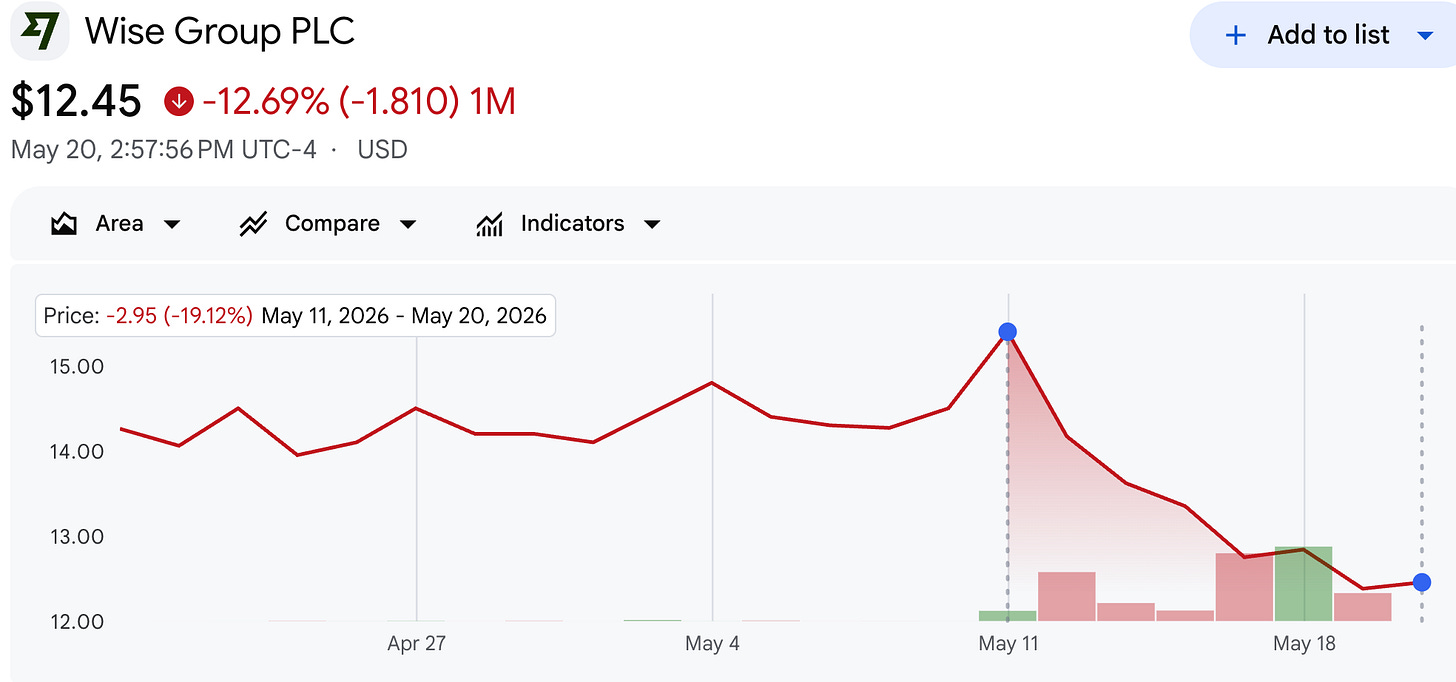
Wise’s bank charter setback seen as speed bump, not roadblock
The gist
Wise’s bid for a U.S. bank charter hit a regulatory wall, but the fintech giant’s infrastructure-led model keeps it firmly on the path to global payment dominance.
What to know
- The OCC denied Wise’s U.S. bank charter in July 2026 over AML compliance and management concerns, halting its plan for direct Fed access.
- Wise still leads the cross-border payments race with 60% instant transfers, ultra-low 0.5-1.5% fees, and a 15-year head start in connecting to local payment rails.
- Investors and analysts see the setback as a temporary speed bump, with Wise planning to reapply under the GENIUS Act while continuing U.S. operations via money transmitter licenses.
Wise’s Infrastructure Edge
Wise’s vertical integration and pricing innovation have built a durable moat, allowing it to outpace banks and fintech rivals in both speed and scale—even as it pivots toward higher-margin services and dual market listings.
By early 2026, Wise had firmly positioned itself as a payment infrastructure powerhouse, leveraging a product moat built on pricing innovation and vertical integration to disrupt traditional cross-border payment models. Charging a mere 0.5-1.5% fee using mid-market exchange rates—vastly undercutting banks’ typical 8-12% costs—Wise not only accelerated transfer speeds with 60% arriving instantly but also drove rapid transaction volume growth despite short-term financial underperformance.
Wise’s strategic move to build direct connections to national payment systems, including its 2025 application to create a U.S. national trust bank and seek a Federal Reserve master account, exemplifies its ambition to bypass costly intermediaries and gain tighter control over U.S. dollar settlements. This vertical integration not only reduces costs and speeds transfers but also enables Wise to rent its proprietary infrastructure to banks, distinguishing it from consumer-focused competitors like Revolut and Nubank.
Expanding beyond its core cross-border transfers, Wise has diversified into higher-margin services such as card payments, which contributed $0.6 billion of its $1.9 billion transaction revenue in FY2026. This shift, combined with its dual listing on Nasdaq and London, enhances institutional visibility and supports accelerated U.S. market expansion, signaling a deliberate structural pivot away from London's historically lower fintech valuations.
Wise’s deliberate strategy of continuously lowering its take rate—dropping to 52 basis points in 2026 with plans for further quarterly cuts—creates a virtuous cycle akin to Costco and Amazon’s models: lower prices attract volume, which reduces unit costs and funds additional price cuts. This pricing discipline not only fuels customer acquisition but also serves as a competitive lever against banks contemplating building their own cross-border capabilities, cementing Wise’s platform as the cost-effective alternative. Meanwhile, its B2B segment has reaccelerated to 20% growth following a compliance-driven onboarding pause, underscoring strong momentum in its higher-margin offerings.

Dominance Over Stablecoins
Wise’s direct access to local payment rails and robust multi-currency platform have made it the benchmark in remittances, outclassing stablecoin and card competitors on cost, speed, and regulatory reliability.
By early 2026, Wise’s 15-year strategic headstart in bypassing correspondent banks to secure direct access to local payment networks has established it as the gold standard in remittances and FX settlement. This foundational infrastructure not only challenges the entrenched dominance of card giants but also redefines the network and infrastructure landscape amid the rapid expansion of the onchain economy, positioning Wise as a pioneering force in fintech evolution.
Wise Plc. has solidified its dominance in cross-border payments by outpacing emerging stablecoin solutions on multiple fronts—cost efficiency, transaction speed, and regulatory compliance. This competitive edge is deeply rooted in its exclusive access to local clearing systems and robust multi-currency capabilities, which together form a formidable moat that shields it from the volatility and regulatory uncertainties plaguing stablecoin yield products and other fintech challengers.

Regulatory Clash and Fallout
Wise’s bold push for a U.S. bank charter collided with a rare, public OCC rejection over AML concerns—making it the only fintech to face such a rebuke since 2020 and forcing a strategic reset under new regulatory frameworks.
Wise’s strategic pursuit of a national trust bank charter with the OCC, initiated in July 2025, was designed to revolutionize its U.S. operations by establishing direct payment infrastructure and obtaining a Federal Reserve master account to bypass intermediary banks. This ambition aimed to streamline U.S. dollar settlements, reduce costs, and accelerate transfers, reflecting a bold move to gain tighter control over its largest currency flow. However, this initiative collided with entrenched regulatory caution and incumbent banks’ protective stance, which have historically been wary of fintechs encroaching on traditional banking privileges, underscoring the challenging landscape for fintechs seeking full banking capabilities in the U.S.
The OCC’s unprecedented denial of Wise’s bank charter in July 2026 marked a significant regulatory rebuke centered on persistent anti-money laundering (AML) and compliance deficiencies, as well as concerns about the management team’s ability to mitigate money-laundering and terrorist-financing risks. This decision referenced Wise’s prior $4.2 million multistate AML penalty from July 2025 and highlighted unresolved supervisory issues, signaling a rare and confrontational regulatory posture that diverged sharply from the generally favorable fintech charter approvals under Comptroller Gould. Unlike the typical softer regulatory approaches—such as conditional approvals or encouraging voluntary withdrawals—the OCC issued a formal public denial with a fitness finding, making Wise the only fintech out of 19 applicants since 2020 to face outright rejection.
Complicating Wise’s charter ambitions, regulatory shifts such as the Federal Reserve’s May 2026 proposal restricting payment system access for uninsured trust banks undermined the viability of Wise’s original strategy to secure a master account and direct Fed payment system connectivity. Despite this setback, Wise remains committed to its U.S. market presence by continuing operations under existing money transmitter licenses across 48 states and four territories, while planning to reapply for a charter under the emerging GENIUS Act framework. This persistence reflects Wise’s recognition of evolving regulatory demands and its intent to adapt its operational model to maintain a significant role in the U.S. payments ecosystem amid ongoing compliance enhancements.
Nonbank Model, Maximum Reach
Wise’s refusal to lend deposits and focus on direct payment system access has redefined fintech risk management, enabling global expansion without traditional banking licenses or deposit insurance.
Wise’s strategic decision to forgo a traditional banking license stems from its core business model that eschews lending customer deposits, instead safeguarding funds in government-issued or guaranteed assets. As Kristo explained, becoming a bank mainly offers the ability to lend deposits—a service Wise’s customers do not demand—rendering deposit insurance unnecessary. This approach not only aligns with Wise’s risk-averse stance but also enhances customer fund protection beyond typical deposit insurance schemes.
Central to Wise’s long-term vision is securing direct access to national payment infrastructures, exemplified by its U.S. national trust bank charter application primarily aimed at obtaining a Federal Reserve master account. This move underscores Wise’s focus on payment system integration rather than traditional banking functions like lending. By embedding itself directly into payment rails, Wise achieves substantial cost reductions and reliability improvements, as seen in Australia’s instant transfer surge from 24% to 83%, Brazil’s 40% fee drop, and the UK’s ninefold cost decrease coupled with a 75% decline in customer contacts.
Wise’s strategy capitalizes on a broader regulatory evolution that increasingly permits nonbank entities to access payment systems without the need to become deposit-taking lenders. Kristo highlighted this global shift, noting Wise’s pioneering roles as the first nonbank connected to the UK’s Faster Payments and, more recently, Japan’s Zengin system. By leveraging these regulatory changes, Wise solidifies its disruptive growth ambitions while navigating evolving compliance landscapes, balancing innovation with prudent risk management.
Setback, Not Surrender
Investors and analysts view Wise’s charter denial as a temporary obstacle, maintaining confidence in its infrastructure-led growth and long-term mission to transform global money movement.
Market reactions to Wise’s regulatory setback, specifically the denial of its U.S. bank charter by the OCC, have been tempered by a broader understanding that this obstacle delays but does not derail the company’s long-term growth trajectory. Analysts emphasize that the denied trust charter alters the timeline rather than the ultimate destination, framing the setback as a temporary hurdle rather than a fundamental shift in Wise’s strategic direction. This perspective encourages investors to look beyond short-term volatility and focus on the company’s resilient infrastructure-led growth model and mission to move trillions, not billions, which remains intact despite regulatory challenges.
Investor sentiment around Wise’s Nasdaq debut and subsequent regulatory news reveals a common misinterpretation of short-term stock price fluctuations as changes in the company’s core prospects. However, the OCC’s decision did not declare Wise’s business model incompatible with a federal charter, nor did it close the door on future applications, underscoring the regulatory setback as a 'no for now rather than a never.' This nuanced understanding supports an optimistic long-term investment thesis, inviting stakeholders to envision Wise’s position a decade from now, grounded in its ability to adapt and continue building its infrastructure to scale financial flows on a massive scale.